Red-Black Tree
Time limit3sMemory limit512 MB
Count the colorings of a binary tree's vertices that satisfy the red-black rules, with fake leaves added at missing children, modulo 1e9+7.
- Level
Hard8 of 10
- Topics
- Dynamic programming, Tree, Combinatorics
- Solved
- No attempts yet
Problem
Most standard libraries implement the set data structure with a red-black tree. In this problem, you count the ways to color the vertices of a given binary tree so that it becomes a red-black tree. Print the answer modulo .
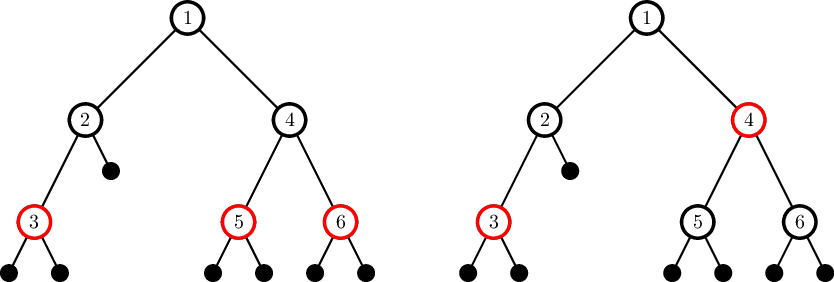
In a binary tree, every vertex with fewer than two children gets fake vertices in the places of the missing children. The tree is a red-black tree if all of the following hold.
- Each vertex is colored either red or black.
- The root and the added fake vertices are black.
- The parent of a red vertex is black.
- Every path from the root to a fake leaf contains the same number of black vertices.
The parent of a black vertex can be black. Two colorings are different if at least one vertex has a different color.
Input
The first line contains one integer , the number of vertices in the tree ().
The next lines describe the tree. Line contains two integers and , the indices of the left and right children of vertex , or 0 if that child is missing. Here or , and or . The root is vertex 1. The input always describes a valid tree.
Output
Print one integer, the number of colorings that make the given tree a valid red-black tree, modulo .