Counting Stairs
Time limit3sMemory limit512 MB
Count symmetric stairs (partitions of n into distinct parts) with n cubes, modulo 998244353, for up to 1e4 queries with n up to 2e5.
- Level
Hard8 of 10
- Topics
- Dynamic programming, Math, Combinatorics, Number theory
- Solved
- No attempts yet
Problem
Remember Barney from problem B? Barney's older sister Cecilia often watches him play with his set of cubes. She also joins Barney in his games and prevails most of the time, shaking his confidence on a daily basis.
One day Cecilia noticed Barney struggling to build a symmetric stair with his cubes. She immediately told him she could not just build a symmetric stair, but even calculate the number of different symmetric stairs consisting of cubes! Can you?
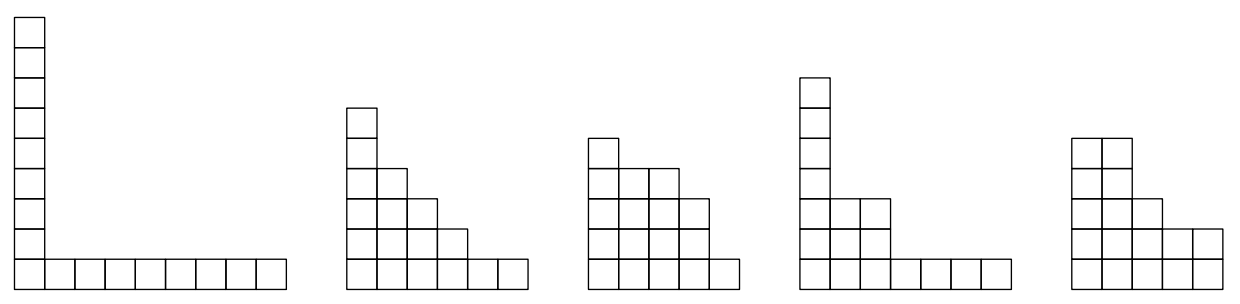
Recall that a symmetric stair consists of one or more towers of cubes, where the heights of towers are non-increasing from left to right, and is symmetric with respect to the line (where the -axis is horizontal and oriented to the right, and the -axis is vertical and oriented upwards). For a more detailed explanation, please refer to problem B statement.
The number of different symmetric stairs can be quite large, so you need to calculate it modulo .
Input
The input contains multiple test cases.
The first line of the input contains a single integer — the number of test cases (). Each of the following lines contains a single integer — the number of cubes in the -th test case ().
Output
For each test case, output a line with a single integer — the number of symmetric stairs with exactly cubes, modulo .
Hint
All different symmetric stairs with cubes are shown below: