Elastic Collisions

Time limit3sMemory limit256 MB

Summary
Two bodies on a line, mass 1 at rest and mass N^2 approaching, bounce elastically between each other and a wall; count the total collisions before both move right forever.
Level

Medium7 of 10

Topics
Simulation, Math, Implementation, Number theory
Solved
No attempts yet

Problem

An elastic collision is a collision in which kinetic energy is conserved. On a line, two bodies with masses m1m_1 and m2m_2 move with velocities (here velocity includes direction) u1u_1 and u2u_2 and collide elastically; after the collision their velocities are

v1=m1−m2m1+m2u1+2m2m1+m2u2v_1 = \frac{m_1-m_2}{m_1+m_2}u_1 + \frac{2m_2}{m_1+m_2}u_2

v2=2m1m1+m2u1−m1−m2m1+m2u2v_2 = \frac{2m_1}{m_1+m_2}u_1 - \frac{m_1-m_2}{m_1+m_2}u_2

For example, if a body of mass 2m2m approaches from the left with velocity vv and a body of mass mm approaches from the right with velocity −v-v, then after the elastic collision their velocities are −v/3-v/3 and 5v/35v/3. Here the sign of a velocity is positive when the body moves from left to right. When a body collides elastically with a stationary wall, the body's speed stays the same and only its direction reverses, so only the sign of the velocity changes.

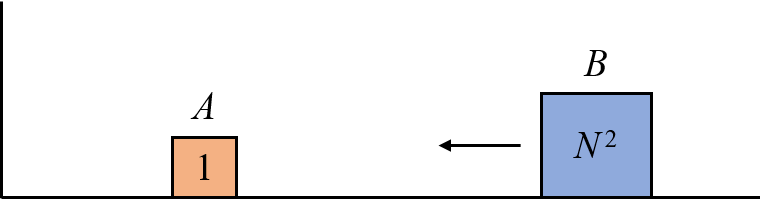
Now consider two bodies AA and BB moving on a line whose left end is blocked by a wall, as in the figure below. The mass of AA is 1 and it is initially at rest. The mass of BB is N2N^2 and it initially approaches from the right of AA. How many collisions occur in total (counting both collisions between AA and BB and collisions between the wall and AA)? Ignore all friction, and all collisions are elastic.

Input

The first line contains a positive integer NN. (1 ≤ NN ≤ 500)

Output

Print the total number of collisions.

Hint

Using Python's fractions module is strongly recommended.

Examples3

  1. Example 1

    Input
    1
    Expected output
    3
  2. Example 2

    Input
    7
    Expected output
    22
  3. Example 3

    Input
    113
    Expected output
    355