Dead-End Detector
시간 제한5초메모리 제한512 MB
양방향 도로 그래프에서 U턴 없이 되돌아올 수 없는 진입 방향을 찾고, 중복되는 표지판을 제거해 최소 개수의 데드엔드 표지판을 정한다.
문제
The council of your home town has decided to improve road sign placement, especially for dead ends. They have given you a road map, and you must determine where to put up signs to mark the dead ends. They want you to use as few signs as possible.
The road map is a collection of locations connected by two-way streets. The following rule describes how to obtain a complete placement of dead-end signs. Consider a street S connecting a location x with another location. The x-entrance of S gets a dead-end sign if, after entering S from x, it is not possible to come back to x without making a U-turn. A U-turn is a 180- degree turn immediately reversing the direction.
To save costs, you have decided not to install redundant dead-end signs, as specified by the following rule. Consider a street S with a dead-end sign at its x-entrance and another street T with a dead-end sign at its y-entrance. If, after entering S from x, it is possible to go to y and enter T without making a U-turn, the dead-end sign at the y-entrance of T is redundant. See Figure E.1 for examples.
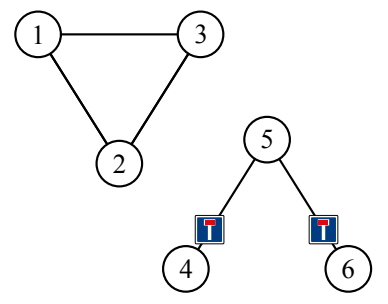
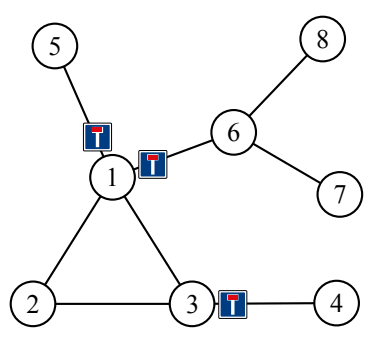
Figure E.1: Illustration of sample inputs, indicating where non-redundant dead-end signs are placed.
입력
The first line of input contains two integers n and m, where n (1 ≤ n ≤ 5 · 105) is the number of locations and m (0 ≤ m ≤ 5 · 105) is the number of streets. Each of the following m lines contains two integers v and w (1 ≤ v < w ≤ n) indicating that there is a two-way street connecting locations v and w. All location pairs in the input are distinct.
출력
On the first line, output k, the number of dead-end signs installed. On each of the next k lines, output two integers v and w marking that a dead-end sign should be installed at the v-entrance of a street connecting locations v and w. The lines describing dead-end signs must be sorted in ascending order of v-locations, breaking ties in ascending order of w-locations.