Bad Treap
Time limit2sMemory limit512 MB
Output n distinct integers so that a treap with priorities y = sin(x) has height n, forming a single chain.
- Level
Medium7 of 10
- Topics
- Math, Number theory, Tree
- Solved
- No attempts yet
Problem
A treap, also known as a Cartesian tree, is a data structure that stores a set of keys in a binary search tree.
Each node of this tree is characterized by a pair (x, y).
The x values of the nodes are the stored keys. They obey the binary search tree rule: all x values in the left subtree of a node are smaller than its x value, and all x values in the right subtree are larger.
The y values of the nodes obey the heap rule: the y value of a node is less than or equal to the y value of its parent.
The y value for each created node is usually chosen randomly according to some distribution. This gives good average time complexity for many operations.
The name is a portmanteau of two words: TRee + hEAP = TREAP.
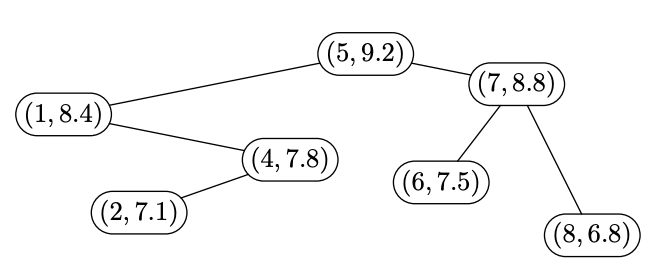 | 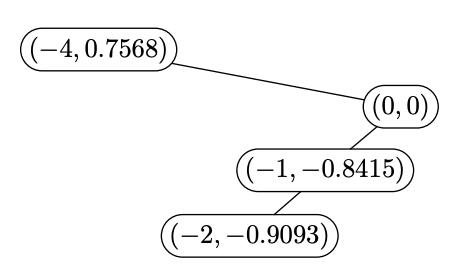 |
| A treap with 7 nodes; its height is 4 | A treap for the sample test |
Benjamin decided that nondeterminism in choosing y is bad, because the execution time changes from one run to another. He calculates y for each node deterministically from its x, using the rule . He is especially glad that distinct integer x values always have distinct y values.
Barbara knows that a nondeterministic treap performs worst on a bad random sequence, while a deterministic treap performs worst on a bad set of keys. She wants to show Benjamin n integer keys that, when stored in his data structure, form a treap of height n, the most unbalanced case possible.
Input
The input is a single integer n ().
Output
Output n lines, each containing a distinct integer key. All keys must be between and , inclusive. A treap built on these keys with the rule must have height n.