Hiking Mania
Time limit2sMemory limit512 MB
Given a tree rooted at node 1, sum over all pairs (i,j) the number of distinct edges on the shortest i-to-j walk forced to pass through the root.
- Level
Medium7 of 10
- Topics
- Tree, DFS, Combinatorics, Math
- Solved
- No attempts yet
Problem
There is a hiking trail on the mountain behind the neighborhood. The trail consists of small huts connected by footpaths. A footpath connects two huts in both directions, and its length is 1. From any hut, you can reach every other hut by following footpaths. The huts are numbered from 1 to , and hut 1 is at the summit. Every footpath on the shortest path from hut 1 to any other hut always goes downhill.
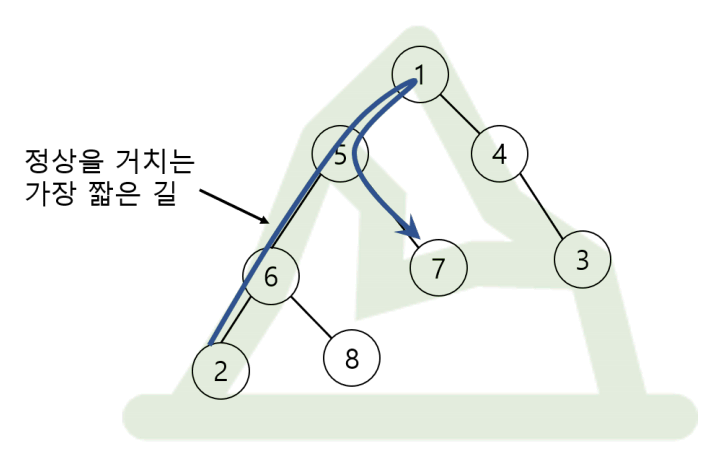
Cheolsu is a hiking maniac. Whenever Cheolsu travels from one hut to another, he always follows the shortest path that passes through the summit. The diversity of such a path is defined as the number of footpaths it contains. Note that a footpath traversed more than once is counted only once.
The figure below shows one possible situation. Hut 1 is at the summit, and huts 3 and 4 are connected by a footpath.
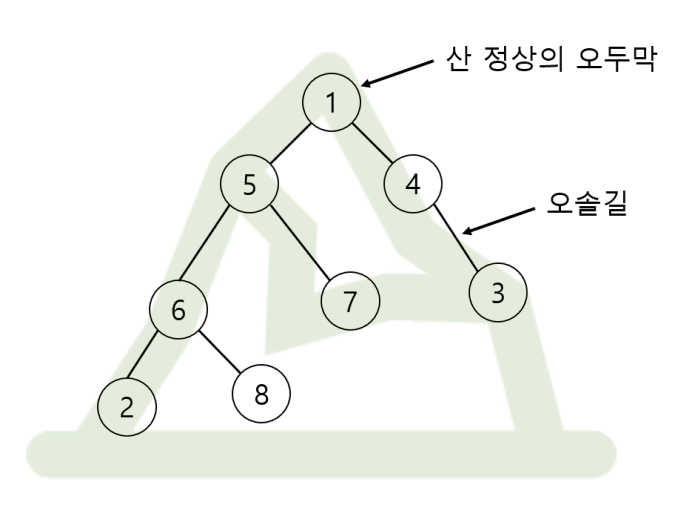
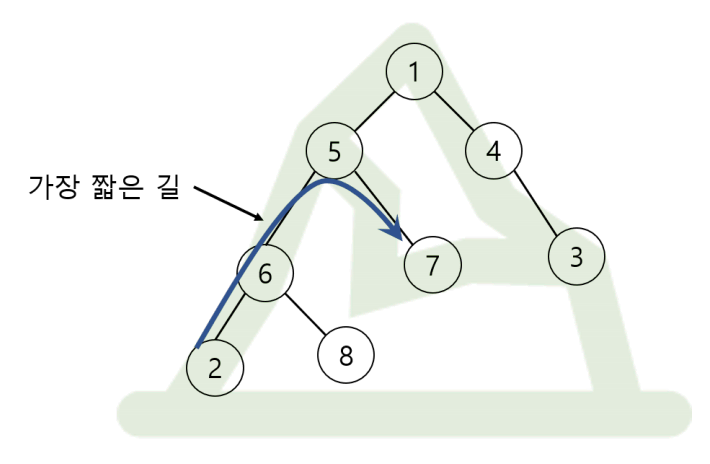
The figure below shows the shortest path from hut 2 to hut 7.
The figure below shows the shortest path from hut 2 to hut 7 that passes through the summit.
Given the structure of the trail as input, write a program that computes, for every pair with , the total sum of the diversity of the path Cheolsu takes from hut to hut .
Input
The first line contains . The next lines each contain two hut numbers separated by a single space. This means the two huts are connected by a footpath.
Output
Print the answer to the problem on the first line.