Grid City
Time limit1sMemory limit512 MB
Given an R x C grid of street tiles, find the fewest 90-degree rotations so every street connects two junctions, or -1 if impossible.
- Level
Medium7 of 10
- Topics
- Graph, Matrix, Implementation
- Solved
- No attempts yet
Problem
Indonesia is moving its capital from Jakarta to another city in Kalimantan. The national city planners have proposed a new city plan. The new city will be built on a rectangular piece of land, and the plan divides the land into a grid of cells with rows and columns. The planners believe this grid design can represent a "modern" image of Indonesia.
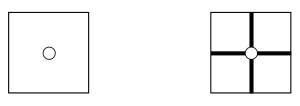
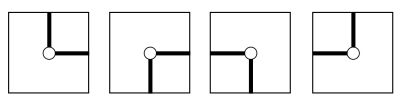
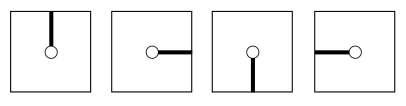
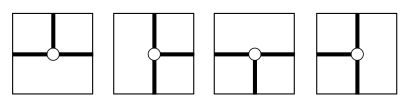
Each cell has exactly one junction at its center. At most 4 streets connect to that junction. Each street runs horizontally or vertically. A cell can have only 14 possible layouts:
- The junction connects to exactly zero or four streets (2 possible layouts).
- The junction connects to exactly two streets forming an L shape (4 possible layouts).
- The junction connects to exactly one street (4 possible layouts).
- The junction connects to exactly three streets (4 possible layouts).
The planners found that some streets end without reaching any junction. Such a street serves no purpose because it does not connect two junctions. In the example below with and , the triangles mark streets whose end is not on a junction.
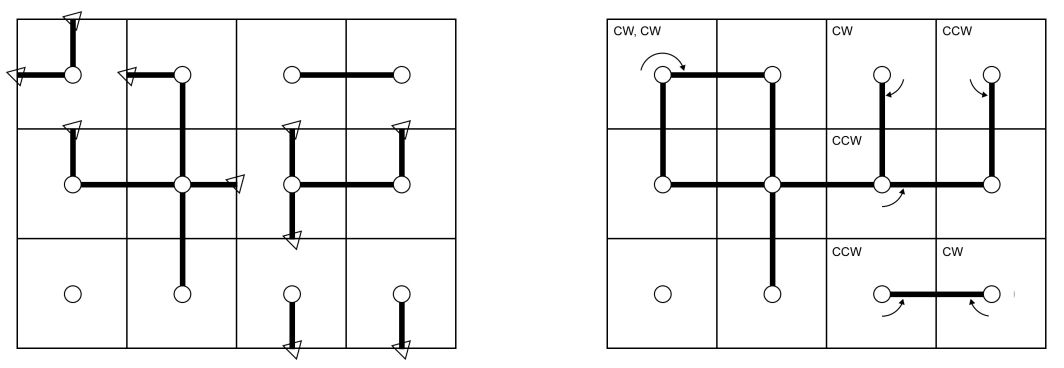
To fix this, you can rotate one or more cells clockwise (CW) or counter-clockwise (CCW) by 90 degrees. A 180-degree rotation takes two rotations, either (CW, CW) or (CCW, CCW). The right side of the example shows one arrangement that makes every street connect two different junctions, using a total of 7 rotations.
Find the minimum number of rotations needed so that every street connects two different junctions.
Input
The first line contains two integers and (), the number of rows and columns. Each of the next lines contains strings, one per cell. Each string is a 4-bit string in the format NESW, where N, E, S, and W are each 0 or 1. A 1 means a street goes in that direction from the junction, and a 0 means no street does. No cell has the layout 1010 or 0101.
Output
Print one integer on a line: the minimum number of rotations needed so that every street connects two different junctions, or -1 if this is impossible.