Exploring Caves
InterviewTime limit2sMemory limit512 MB
Each cave's path is given as successive displacement vectors; reconstruct the room coordinates and report the point farthest from the origin, breaking ties by largest x.
- Level
Easy3 of 10
- Topics
- Simulation, Implementation, Math, Array
- Solved
- No attempts yet
Problem
There are many caves deep in the mountains of the countryside. According to legend, each cave has a treasure hidden in the room farthest from the cave entrance. The Shogun has ordered his samurai to explore these caves with Karakuri dolls (robots) and find all the treasures. These robots move through the caves and record the relative distances and directions between rooms.
Each room in a cave maps to a point on an integer grid (x, y ≥ 0). For each cave, the robot always starts at the entrance, moves along the grid, and returns to the entrance (which also serves as the exit). The treasure in each cave is hidden in the room farthest from the entrance, measured by Euclidean distance, i.e. the distance of the room at point (x, y) from the entrance (0, 0) is defined as the square root of (x*x+y*y). If more than one room has the same farthest distance from the entrance, the treasure is hidden in the room having the greatest value of x. While the robot explores a cave, it records how it has moved. Each time it takes a new direction at a room, it notes the difference (dx, dy) from the last time it changed its direction. For example, suppose the robot is currently in the room at point (2, 4). If it moves to room (6, 4), the robot records (4, 0), i.e. dx=6-2 and dy=4-4. The first data is defined as the difference from the entrance. The following figure shows the rooms in the first cave of the Sample Input. In the figure, the farthest room is the square root of 61 distant from the entrance.
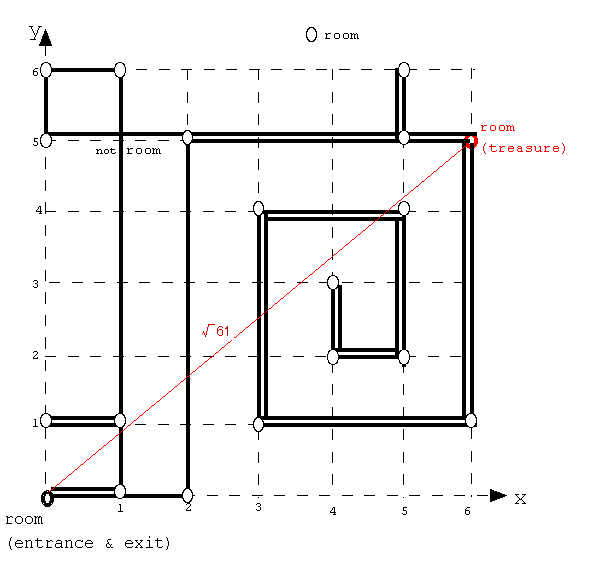
Based on the records that the robots bring back, determine the rooms where treasures are hidden.
Input
In the first line of the input, an integer N showing the number of caves in the input is given. Integers dxi and dyi are i-th data showing the differences between rooms. Note that since the robot moves along the grid, either dxi or dyi is zero. An integer pair dxi = dyi = 0 signals the end of one cave's data, which means the robot finished the exploration for the cave and returned back to the entrance. The coordinates are limited to (0,0)-(1000,1000).
Output
Print the position (x, y) of the treasure room on a line for each cave.