Toy Orange Making
Time limit6sMemory limit1024 MB
Treating each block as an edge between two colors, answer range queries: can blocks l to r all form circles, and if so, what is the minimum number of circles?
- Level
Medium7 of 10
- Topics
- Graph, Union-find, Divide and conquer
- Solved
- No attempts yet
x
Jeonghu, a 17-year-old baby, is playing with his favorite snap-together toy. He wants to build an orange from it.
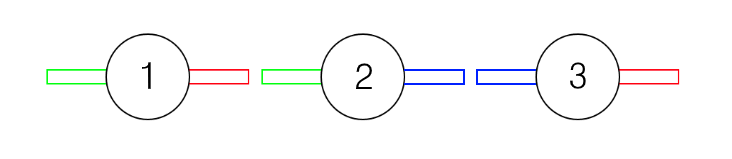
Jeonghu has snap-together toy blocks. Each block has two connectors, and two blocks can be joined by connecting their connectors. Each connector is painted one of colors, numbered from to . Block has a connector of color and a connector of color . The two connector colors are always different, so . The figure below shows three blocks.
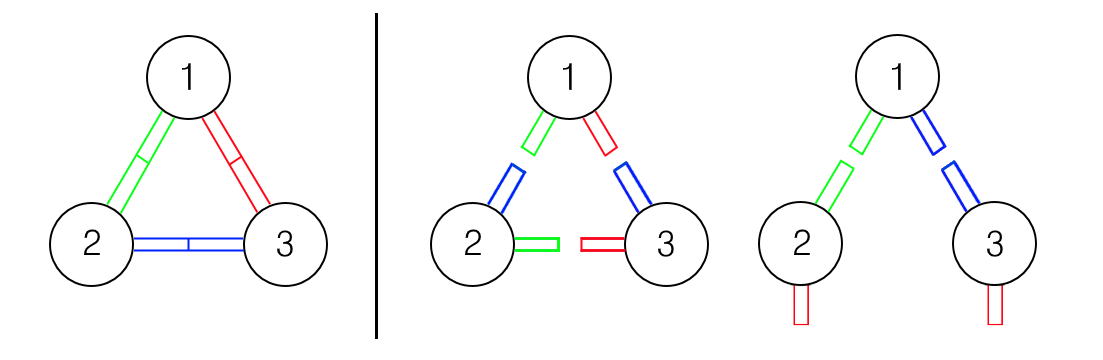
An orange is round, so the blocks must form a circle to make one. Only connectors of the same color can be joined. The figure below shows a valid orange and two invalid ones. The first example is valid. The second cannot be joined because the connector colors differ. The third is not a valid orange because the blocks do not form a circle.
Jeonghu lined up the blocks and numbered them from 1 to . He wants to make oranges from a run of consecutive blocks, but he cannot work out how, so he asked you for help. Write a program that answers the following two kinds of queries.
- Can you make at least one orange using all blocks in the range ? It does not have to be a single orange.
- If so, what is the minimum number of oranges that can be made?