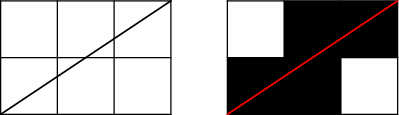
Tomas is a computer graphics student. He has a homework which is very easy for him. He has to make a program that draws a line from point (0, 0) to (a, b), where integers a, b (a>0, b> 0) are the input of the program.
He uses the following algorithm. He divides the plane into squares 1x1 – these squares are pixels. When the line from (0, 0) to (a, b) intersects a square in more than one point, the square (pixel) will be black. Otherwise it will be white. Look at the example:

Tomas is a computer graphics student. He has a homework which is very easy for him. He has to make a program that draws a line from point (0, 0) to (a, b), where integers a, b (a>0, b> 0) are the input of the program.
He uses the following algorithm. He divides the plane into squares 1x1 – these squares are pixels. When the line from (0, 0) to (a, b) intersects a square in more than one point, the square (pixel) will be black. Otherwise it will be white. Look at the example:
The first line of the input file contains an integer T specifying the number of test cases. Each test case is preceded by a blank line.
Each test case looks as follows: The one and only line contains a positive integer N. You can assume that number N has at most 47 divisors.
For each test case output one line with one integer – the number of lines that use exactly N black pixels.