Intercastellar
Time limit2sMemory limit512 MB
Each even piece is repeatedly halved, always choosing the rightmost even piece, and queries ask for the final length at given positions from the left.
- Level
Medium6 of 10
- Topics
- Simulation, Implementation, Binary search, Math
- Solved
- No attempts yet
Problem
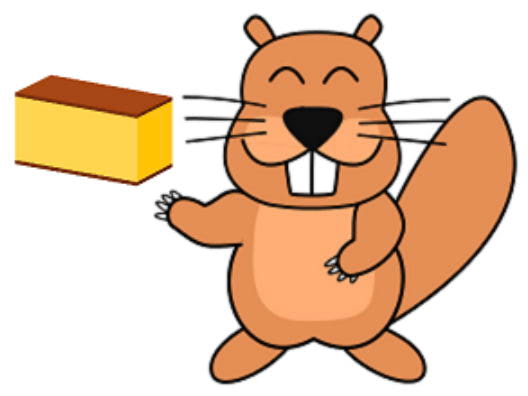
In 30XX, thanks to the constant efforts of scientists and engineers, interaction among different planets has become very active. Bitaro is a beaver who works as an ambassador of an exchange program. His task is to introduce foods from the Earth to the inhabitants of different planets. He will leave for the JOI Planet at 1:00 in the afternoon.
Bitaro is planning to introduce castella to the inhabitants of the JOI Planet. The castella was already cut into several pieces. Castella is a baked sponge cake made of flour, egg, sugar, and starch syrup.
The shape of the castella is a horizontally long rectangular box. It was cut into pieces. The length of the -th piece () from the left is an integer .
A couple of minutes ago, it turned out that the inhabitants of the JOI Planet do not like even integers. To cope with this problem, you will perform the following sequential operations until pieces of even length disappear.
- Among the pieces of even length, you choose the rightmost one.
- You cut the chosen piece into two pieces of equal length. Namely, if the length of the chosen piece is , you cut it into two pieces of length . You do not move the position of the pieces.
To confirm whether the operations are performed correctly, Bitaro will ask you questions. The -th question () is as follows.
- After all the operations are performed, what is the length of the -th piece from the left?
Given information of the castella and the questions, write a program which answers the questions.
Input
Read the following data from the standard input. Given values are all integers.
\begin{align\*} & N \\ & A\_1 \\ & A\_2 \\ & \vdots \\ & A\_N \\ & Q \\ & X\_1 \\ & X\_2 \\ & \vdots \\ & X\_Q\end{align\*}
Output
Write lines to the standard output. The -th line () should contain the answer to the -th question.
Constraints
- .
- ().
- .
- () ().
- ().
- After all the operations are performed, the castella is cut into at least pieces.