Antialiasing
Time limit4sMemory limit1024 MB
Given a convex polygon and a pixel, find the fraction of the pixel's area inside the polygon as a reduced fraction.
- Level
Medium6 of 10
- Topics
- Geometry, Implementation, Math
- Solved
- No attempts yet
Problem
To reduce aliasing effects, computer graphics systems render a polygon by setting the brightness of each pixel in proportion to the area of the pixel inside the polygon. If a pixel is completely inside the polygon, that pixel is set to the brightest intensity. If only half of the pixel is inside the polygon, then the pixel is set halfway between darkest and brightest.
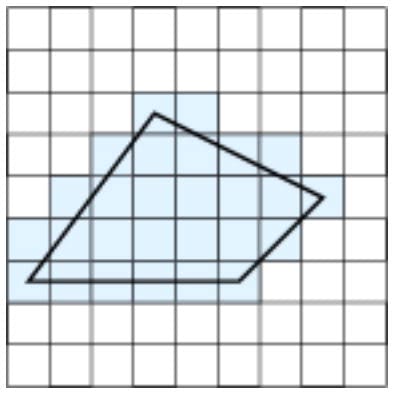
Given a convex polygon and a pixel location, determine the fraction of the pixel's area that is inside the polygon. Each pixel is square, and is indexed by its row and column coordinates and . If a vertex of the polygon is located at , then the vertex is located at the center of the pixel at row and column . Rows are numbered from starting from the top row, and columns are numbered from starting from the leftmost column.
Input
The first line of input specifies two integers (), which is the number of vertices in the convex polygon, and (), which is the number of queries. The next lines each contains two integers and giving the coordinates of the polygon in counterclockwise order. The next lines each contains two integers and indicating the coordinates of the pixel we are interested in. It is guaranteed that the area of the polygon is positive. All coordinates satisfy and .
Output
For each query, display a line indicating the fraction of the pixel's area inside the polygon. The fraction should be in lowest terms.