Gyeongnodang Punk 2077
Time limit1sMemory limit1024 MB
Given the English-mode keystrokes of a Korean name typed on a 2-set keyboard, decide whether the last syllable has a final consonant.
- Level
Medium4 of 10
- Topics
- String, Implementation
- Solved
- No attempts yet
Problem
Sieun is developing an open-world action Go-Stop game, Gyeongnodang Punk 2077, as a capstone project. While adding dialogue, Sieun realized that the game must print either '을' or '를' depending on the user's name. For example, if the name is 도현, it must print 도현'을', and if the name is 인하, it must print 인하'를'. The criterion is whether the last syllable of the name has a final consonant (batchim).
Users must use names made only of Hangul syllables. Every syllable of the name can be formed by picking one initial, one vowel, and one final in order from the table above. For example, the syllable 인 (initial ㅇ, vowel ㅣ, final ㄴ) and the syllable 하 (initial ㅎ, vowel ㅏ, no final) can appear in a user name. In contrast, 짜, 계, 와, and 삵 cannot appear in a user name, because each contains a jamo that is not in the table above.

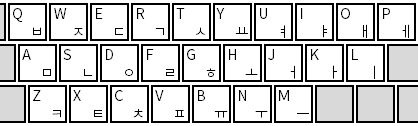
Suppose a user types the name in English lowercase mode on the standard Korean 2-set keyboard shown in the figure. Call the resulting string . Given , write a program that determines whether the last syllable of the original user name has a final consonant.
Input
The first line contains an integer , the length of the string .
The second line contains the string .
Output
Print 1 if the last syllable of the user name has a final consonant. Otherwise, print 0.
Constraints
Hint
The modern Hangul lists of initials, vowels, and finals are as follows.
- Initials: ㄱ, ㄲ, ㄴ, ㄷ, ㄸ, ㄹ, ㅁ, ㅂ, ㅃ, ㅅ, ㅆ, ㅇ, ㅈ, ㅉ, ㅊ, ㅋ, ㅌ, ㅍ, ㅎ
- Vowels: ㅏ, ㅐ, ㅑ, ㅒ, ㅓ, ㅔ, ㅕ, ㅖ, ㅗ, ㅘ, ㅙ, ㅚ, ㅛ, ㅜ, ㅝ, ㅞ, ㅟ, ㅠ, ㅡ, ㅢ, ㅣ
- Finals: (none), ㄱ, ㄲ, ㄳ, ㄴ, ㄵ, ㄶ, ㄷ, ㄹ, ㄺ, ㄻ, ㄼ, ㄽ, ㄾ, ㄿ, ㅀ, ㅁ, ㅂ, ㅄ, ㅅ, ㅆ, ㅇ, ㅈ, ㅊ, ㅋ, ㅌ, ㅍ, ㅎ
However, for convenience in this problem, the kinds of initials, vowels, and finals that can appear in the input are restricted.