Coding Is a Physical Education Subject
Time limit0.5sMemory limit1024 MB
Given N, a multiple of 4, print the C++ integer type name with N/4 copies of "long" followed by "int" that can store up to N bytes.
- Level
Easy2 of 10
- Topics
- String, Implementation
- Solved
- No attempts yet
Problem
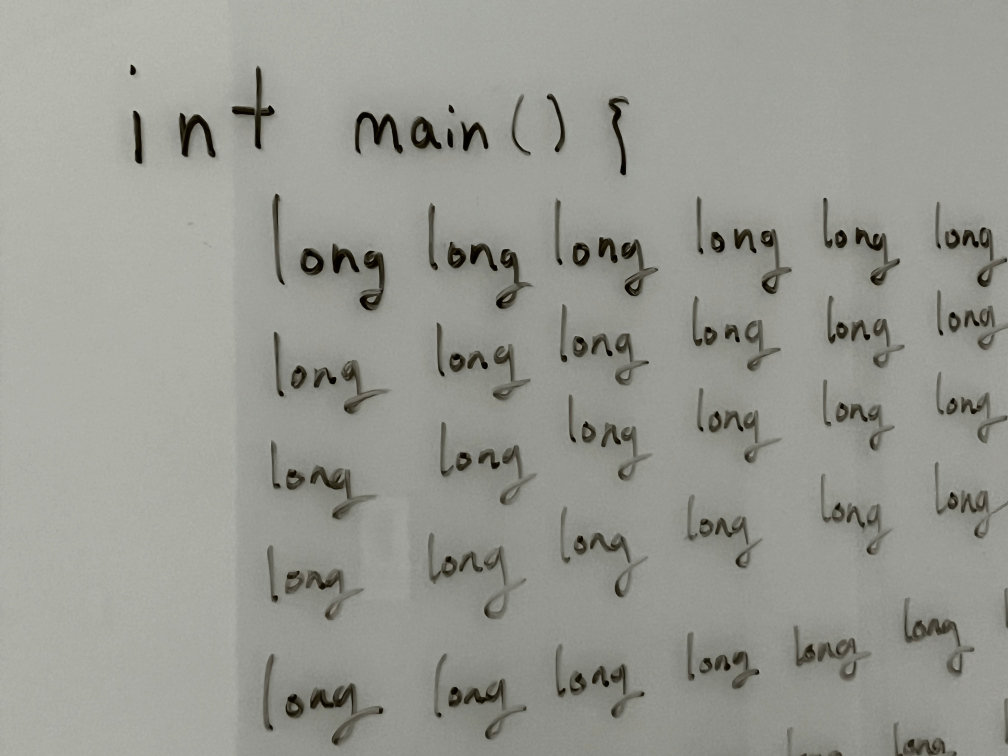
Today is Hyea's job interview. She answered the earlier questions well, and now she is asked to write code directly on the board. The problem is to add two numbers. Hyea had studied the C++ book carefully, so she wrote a simple code that adds two numbers on the board. The interviewer saw the code and asked the next question: "If the input and output are integers of bytes, how should the program be implemented?"
Hyea recalled the integer types from the book. The book says that long int can store integers up to 4 bytes, and long long int can store integers up to 8 bytes. Hyea thought: "Does each extra long before int add 4 bytes of storage? Then long long long int should store up to 12 bytes, and long long long long int up to 16 bytes!" Ignoring the surprised face of the interviewer, she began writing integer types on the board.
Input
The first line contains the integer . ; is a multiple of 4$$)
Output
Print the name of the integer type that Hyea thinks can store integers up to bytes.
Hint
In the output, there is one space between long and long, and one space between long and int.
The range of numbers each integer type can store in C++ may differ depending on the environment. Also, if you try to compile code that uses a type like long long long int with the GCC C++ compiler, compilation fails with the error message 'long long long' is too long for GCC.