
Towards Ambient Computing
Warning
History of Eidetic Memory Devices
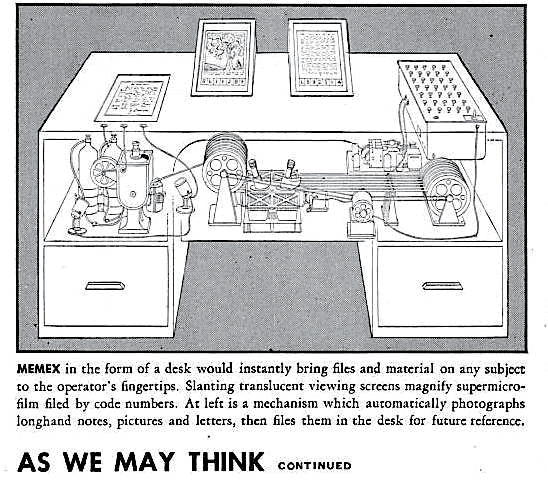
In 1945, the American scientist Vannevar Bush came up with the Memex in his essay As We May Think. The idea was to store a person's conversations, records, and communications in a compressed, mechanical form and pull them back up quickly. The Memex was meant to extend memory. Bush often gets credit for the first vision of the Internet, because closely connected, augmented memories help people think. And this was before ENIAC even existed. Pretty wild.
Ted Chiang, the science fiction writer, imagined his own memory aid in his 2013 novel The Truth of Fact, the Truth of Feeling. A journalist uses a device called Remem to record every part of their life and recall any of it instantly. In a parallel story, written language shakes up a society that used to rely on oral history. If a personal, permanent memory device like Remem became real, it could hit as hard as the internet or written text did.
And it's becoming real.
Prehistoric Lifelogging
In 1994, the inventor Steve Mann live-streamed what he saw through a wearable camera and display, and by 1998 that had grown into the genre of lifelogging. Devices got smaller and smaller. Then smartphones showed up, and most lifelogging devices became obsolete. The original goal was to stream your life to other people in real time, not so much to remember more. Smartphones were perfect for anyone who wanted to broadcast everything to an audience, so a lot of live bloggers switched, and that gave us a new job called streamer.

Then Lifelogging converted to Remembering More
Once smartphones took over broadcasting, lifelogging tools got smaller and turned into memory aids. Memoto's Narrative Clip from 2013 is the classic example. It takes a photo every 30 seconds to document your whole day.
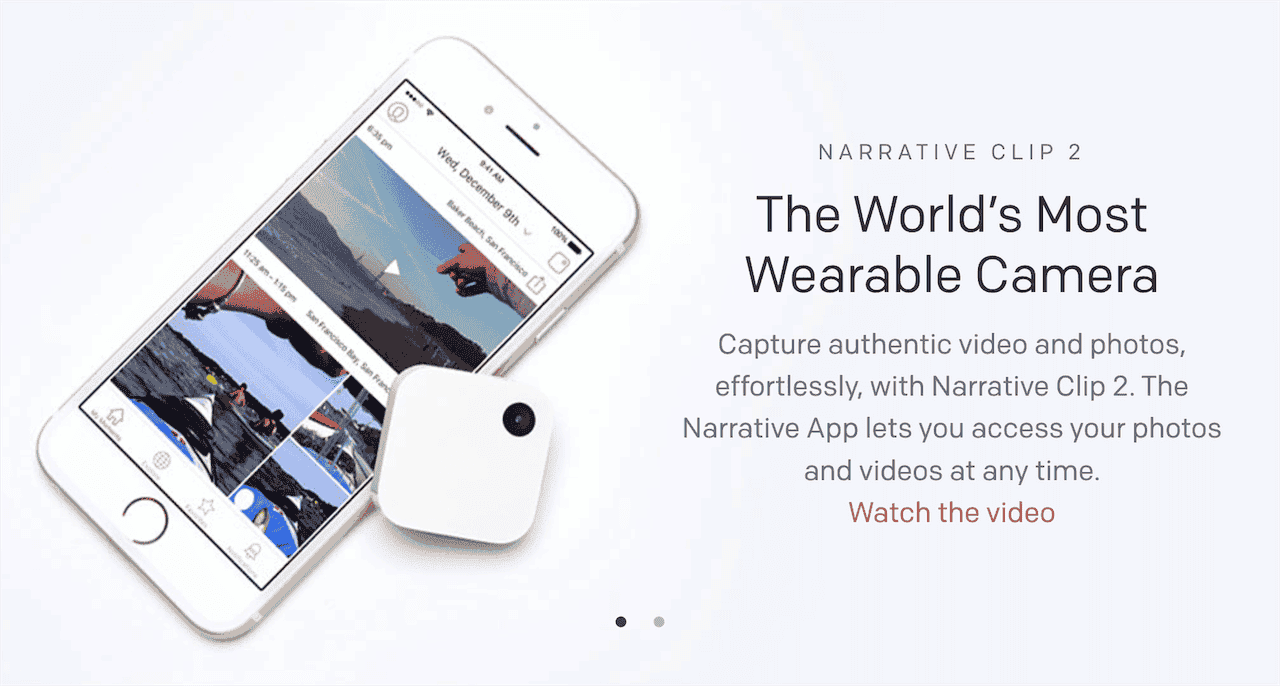
The catch with a camera that shoots on its own is that you end up with thousands of photos a day, and finding the ones that matter is a pain. So in 2016 there was a smarter take, Google Clip. It used AI to decide when a moment was worth a photo. It launched quietly, nobody paid much attention, and it faded away like hundreds of other Killed-By-Google experiments.

The emergence of LLM Lifelogging
Up to this point these were mostly tiny cameras clipped to your body. The big reason was that nothing could summarize the recordings. And then ChatGPT came along.
The first real attempt at an LLM lifelogging device was Robert Dam's Wisper in November 2022. He recorded himself with a phone app and ran the recordings through an LLM. For Dam the big wins were a perfect memory and a personal psychologist (something that could read his conversations and keep an eye on his emotions). But a phone clearly had limits. The software has to run all the time, which kills performance and battery. The only real options were a separate device, or building the software straight into the phone's operating system.
Road towards the Next Apple
A new form factor shifts culture like tectonic plates. Desktops made it normal to sit facing a wall in the corner of a room. Smartphones made it normal to move money while walking down the street. AirPods made it normal to talk out loud like you're talking to yourself. Change the shape of the gadget and you can shake up culture and create new giants. And right now we're on the edge of one of those shifts. The pin.
Soon we might wear a tiny pin, something like an iPod shuffle, around our neck, with AI running in the background all the time. Some might even project images onto your palm. With no display, the battery could last for days. It could record everything you do in a day and hand you a summary.
Sounds like science fiction, but these products are already being built and are slated for release in the next year or so. Here are a few.
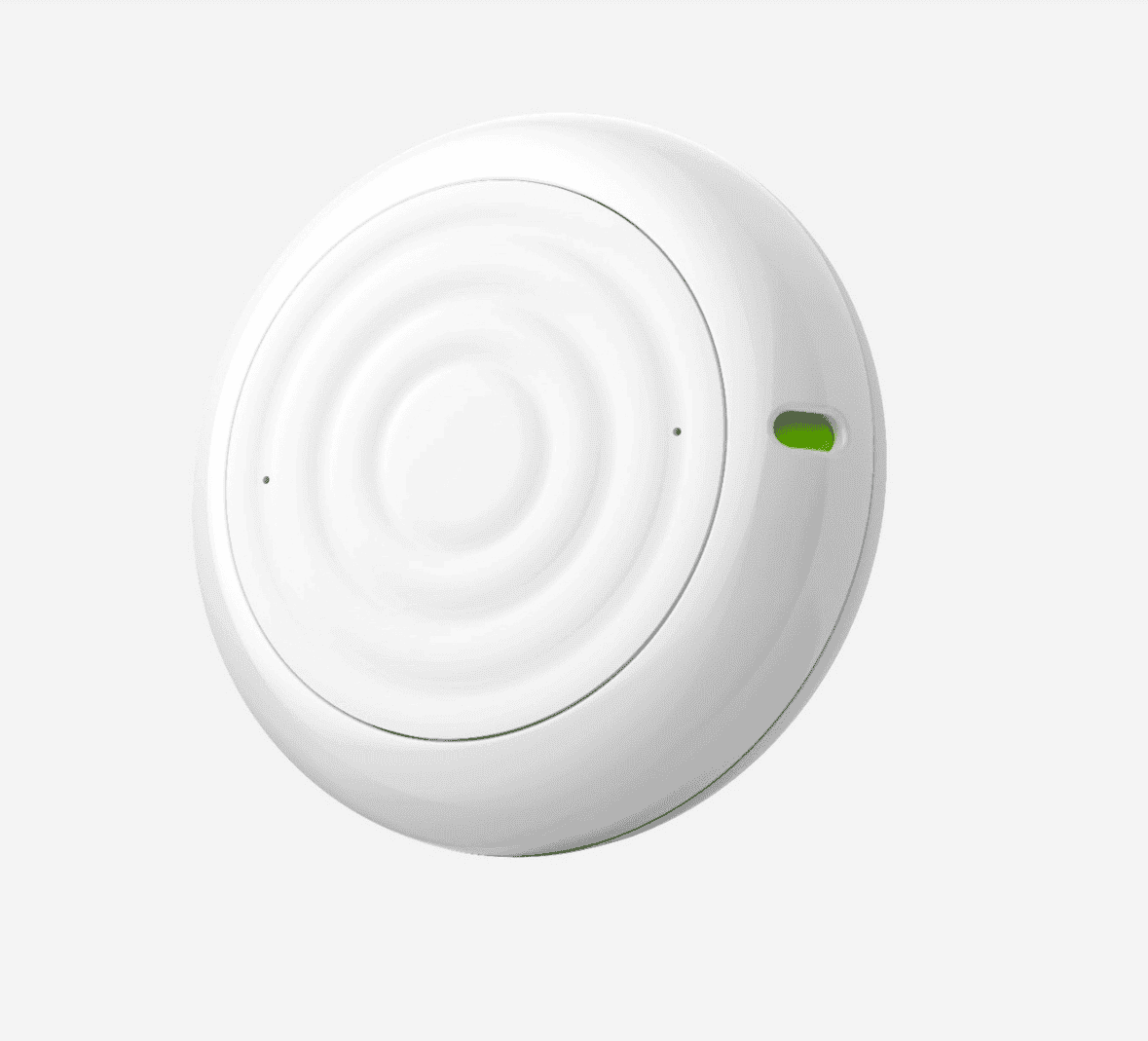
In October 2023, Avi Schiffmann showed off the device he'd been working on, the Tab.
Right after, the Rewind team announced the Rewind pendant.
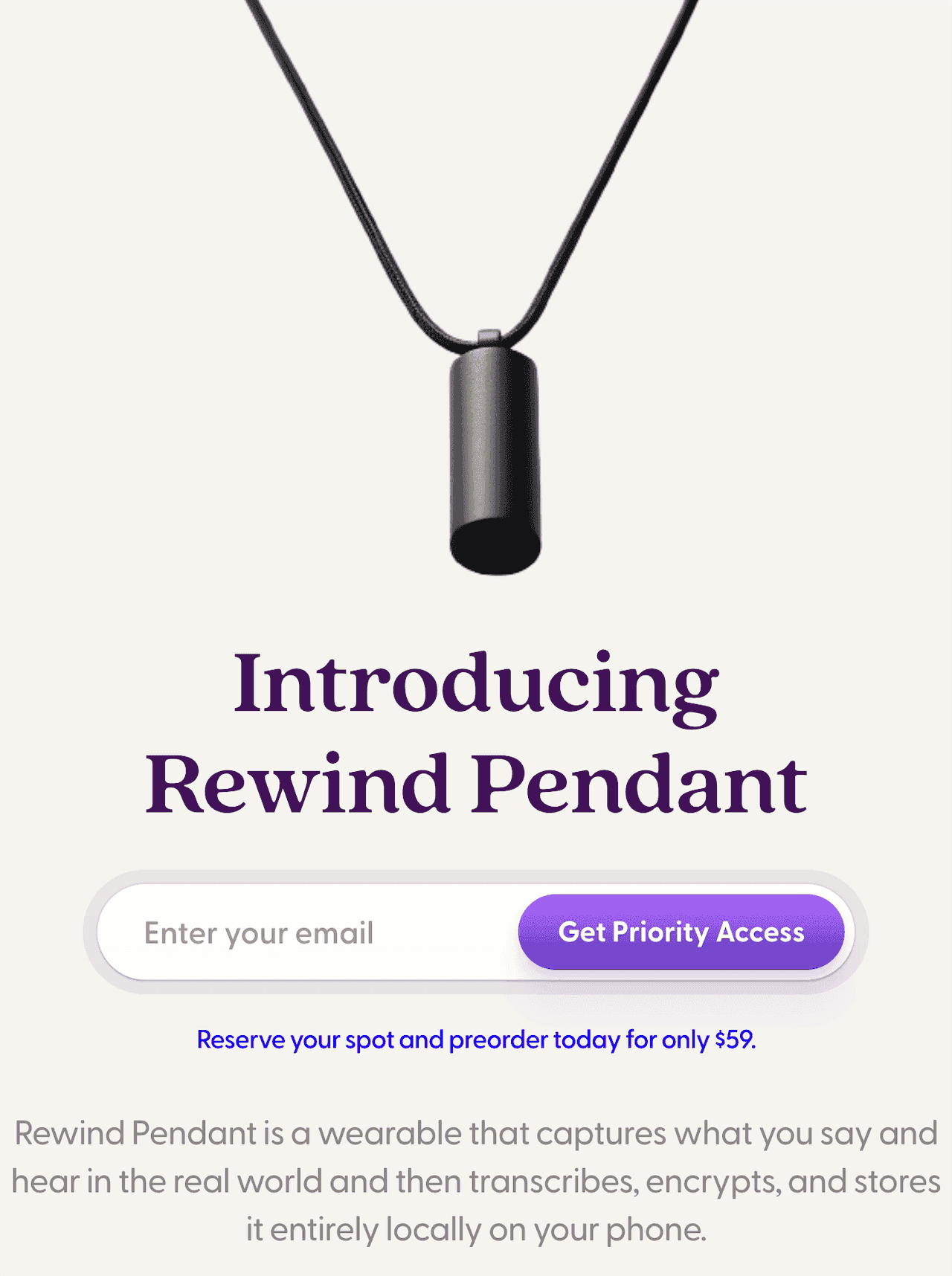
Both pendants use OpenAI Whisper and GPT to record and answer questions on the spot. All of this happened in early October, and judging by how fast things have moved so far, the competition is only going to heat up.
Ambient Computing
And so the idea of ambient computing was born. Humane is a company started by two former Apple directors, one from software and one from design. They want computing that is easily accessible but not intrusive. Their concept is a wearable pin that projects information onto your hand with a fancy laser projector. Think of it as a lifelogging device with a lot more on top.

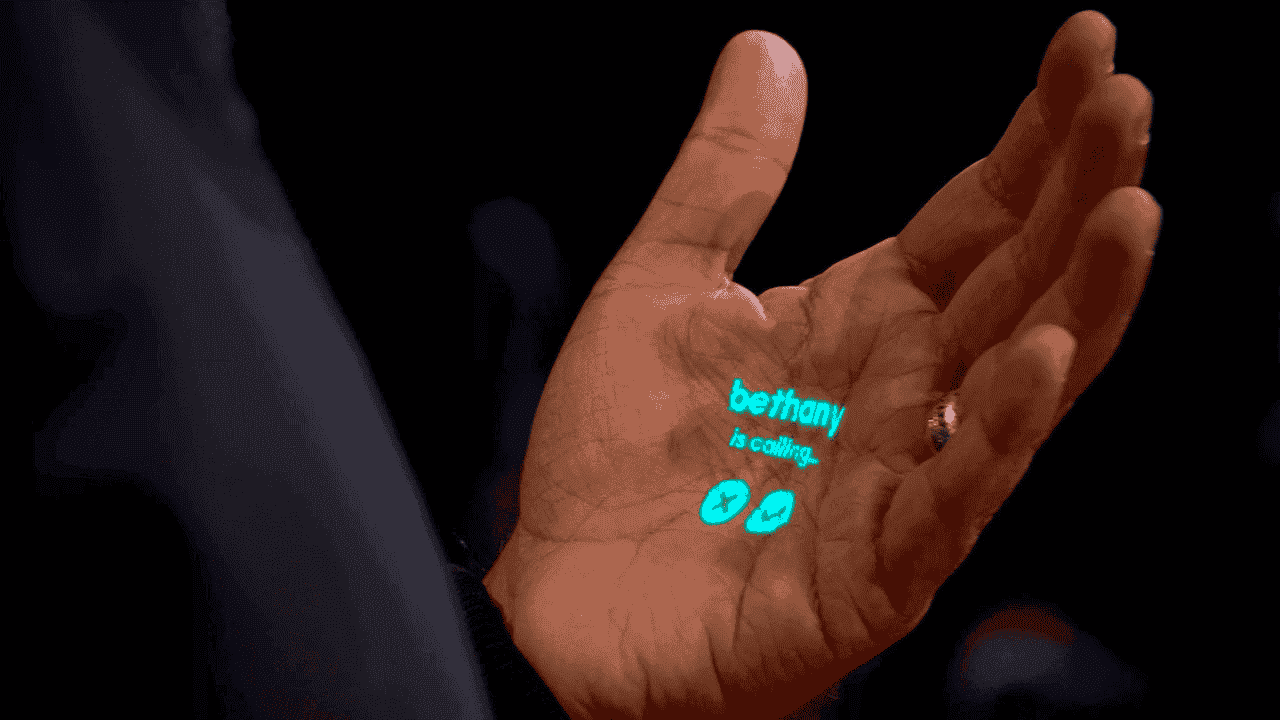
Their pitch was that the device would always be there to help and would remember everything, without the digital addiction modern smartphones so often bring. They believed we could have a healthy relationship with electronics.
Us in the Ambient Computing Era
In that same Ted Chiang novel, The Truth of Fact, the Truth of Feeling, he writes
Psychologists make a distinction between semantic memory-- knowledge of general facts--and episodic memory, or recollection of personal experiences. We've been using technological supplements for semantic memory ever since the invention of writing: first books, then search engines. By contrast, we've historically resisted such aids when it comes to episodic memory; few people have ever kept as many diaries or photo albums as they did ordinary books... We regarded our episodic memories as such an integral part of our identities that we were reluctant to externalize them, to relegate them to books on a shelf or files on a computer.
Part of me wanted to stop this, to protect children's ability to see the beginning of their lives filtered through gauze, to keep those origin stories from being replaced by cold, desaturated video. But maybe they will feel just as warmly about their lossless digital memories as I do about my imperfect, organic memories.
I'm a product of my time, and times change. We can't prevent the adoption of digital memory any more than oral cultures could stop the arrival of literacy, so the best I can do is look for something positive in it. And I think I've found the real benefit of digital memory. The point is not to prove you were right; the point is to admit you were wrong... What digital memory will do is change those stories from fabulations that emphasize our best acts and elide our worst, into ones that--I hope--acknowledge our fallibility and make us less judgmental about the fallibility of others.
The future I want is one where tech is always there to help, but never so everywhere that it drowns out our own thinking. Tech should be a tool, not a drag. It shouldn't grow like a tumor and suck out our energy and focus. We should use it to our advantage and still be able to think and get by on our own.
Tech is not value-neutral. Some people say the person using it is the one responsible, but that ignores the fact that tech gets built because someone wants it for a specific reason. The first people who ask for a technology are never neutral, because they want it for something. Fritz Haber, who invented nitrogen fixation, was anything but neutral when he developed chlorine gas, driven by his German nationalism. He even studied the international law on using poison gas for killing and came up with a way of deploying the gas that let Germany get around it.
Social engineering, everywhere these days, is another place where tech is far from neutral. Social media companies like Facebook are known to have teams working on making their products more addictive. That's not so different from drug cartels looking for stronger drugs. Maybe one day we'll look back on this as an era of barbaric social media manipulation, with no limits at all on harvesting human emotions.
Ambient computing raises the same worry. If we put infinitely scrolling video feeds in our glasses, or even on our irises, will our dopamine systems be safe? I hope these new companies help us build a healthier relationship with tech, because we failed at that during the smartphone revolution. So I hope ambient computing companies put
- people's peace of mind over short-term retention
- human creativity over frantic data collection
- the flourishing of the human mind over the immediate metrics
I'm excited for the ambient computing era, as long as it stays ambient. Readily available, but never intrusive.