길이가 같은 n개의 닫힌 구간이 일직선 위에 있고, 서로 겹치지 않는 m개의 시작 구간 집합 S와 도착 구간 집합 E가 주어질 때, 한 번에 한 명씩 겹치는 구간으로만 이동하며 선택된 구간들이 항상 서로 겹치지 않도록 유지하면서 S에서 E로 가는 최소 이동 순서를 출력하고, 불가능하면 -1을 출력한다.
어려움9그리디구간정렬시뮬레이션아직 제출이 없습니다시간 제한2초메모리 제한512 MBKorean idol groups are famous in the world for dynamic and elaborate group dances, called Kalgunmu. A Korean idol group has m members. One day the members practice their choreography in a stage. Suppose that the stage is simplified as a line. There are n closed intervals of identical length on the stage. Here we shall specify seven rules which the members should follow in every moment of choreography as follows:
Note that two closed intervals [a, b] and [c, d] with a ≤ c intersect if c ≤ b.
The choreography consists of several steps with the following rules:
of the intervals that her/his current interval intersects.
Note that a member cannot move into the interval I if I intersects an interval on which another member stands, according to the rule R3.
Note that the sets S and E are given as in the input.
According to the rules of the choreography, the size of S (or E) is m and the intervals in S (or E) do not intersect each other. Also each member shall move from an interval s in S to an interval e in E through the choreography. We are interested in the minimum number of steps to complete the choreography satisfying the above rules R1 to R7.
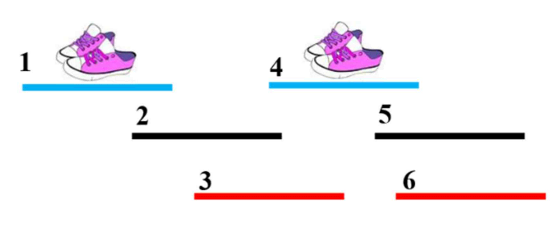
For example, in Figure E. 1, there are six intervals on a stage, which are denoted by numbers from 1 to 6. The blue intervals 1 and 4 are intervals on which two members stand in the start of choreography and the red intervals 3 and 6 are ones in the end.

Figure E. 1 Initial configuration S of the choreography on a stage

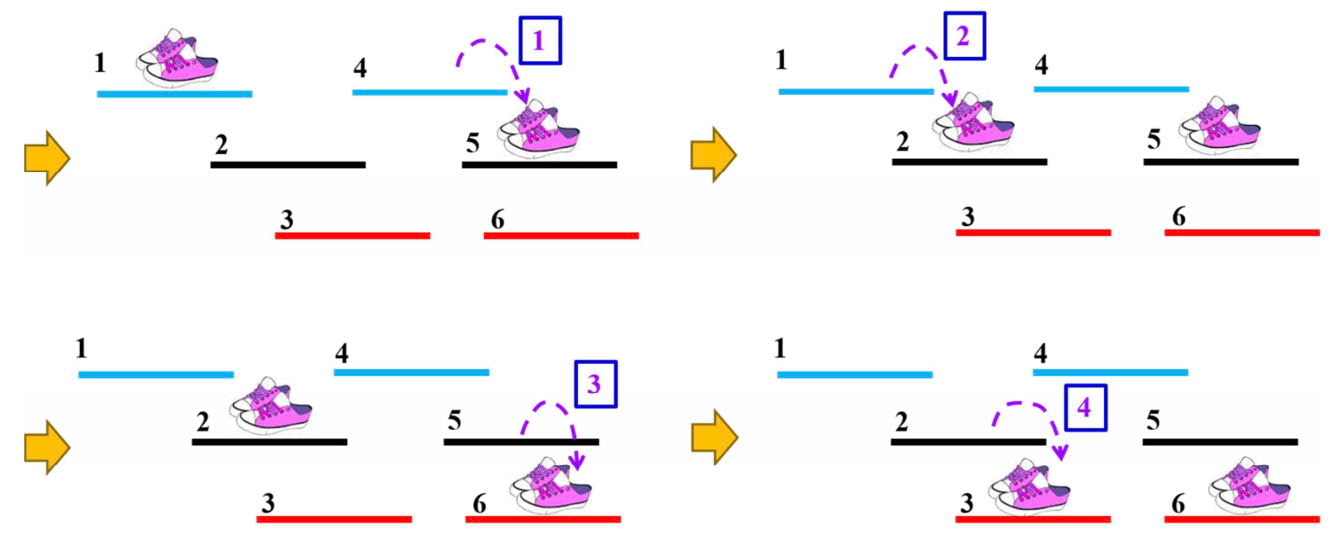
Figure E. 2 Four steps of choreography
At the first step, the member standing on the interval 4 moves into the interval 5. Notice that the member on the interval 1 cannot move into the interval 2 at the first step, because the interval 2 intersects the interval 4 that another member stands on. As in Figure E. 2, two members can move into the red intervals in four steps. But if the member on the interval 4 moves into the interval 6 at the first step, then the choreography would be completed in three steps, which is minimum.
Given m members, n intervals, and two sets S and E for the choreography, write a program to find a choreography from S to E with a minimum number of steps, and output all such steps.
Your program is to read from standard input. The input starts with a line containing two integers, m and n (1 ≤ m ≤ n ≤ 5,000), where m is the number of members and n is the number of intervals on the stage. The intervals are numbered from 1 to n such that the left endpoint of interval i is strictly less than the left one of interval i + 1. The second line contains an integer r, the length of intervals (1 ≤ r ≤ 10,000). The third line contains a sequence of sorted n integers in ascending order where the i-th number is the left endpoint of the interval i, where these numbers are between 0 and 109. The following line contains a sequence of sorted m integers to denote the intervals belonging to the set S in ascending order. The last line contains a sequence of sorted m integers to denote the intervals belonging to the set E in ascending order.
Your program is to write to standard output. The first line should contain the minimum number MIN of steps to complete the choreography. In the following MIN lines, the i-th line contains two integers a and b, where a member moves from the interval a to the interval b at the step i of the choreography with the minimum number of steps MIN. If there are one or more solutions, then print arbitrary one. If there is no solution, then print −1.