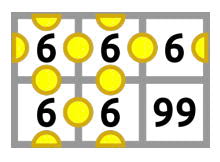
토러스 모양 격자의 각 칸 높이가 주어질 때, 임의의 행이나 열 전체에 1을 더하는 연산을 반복해 이웃한 두 칸의 높이가 같은 쌍의 수를 최대로 만드는 문제입니다.
어려움8그리디수학구현행렬아직 제출이 없습니다시간 제한1초메모리 제한512 MBI’m playing Super Mario Galaxy 3 (thanks for the copy, Nintendo). Most of the levels are small planets in a shape of sphere, but bonus levels are something different. They are in a shape of torus. You can imagine it as rectangle with both pairs of opposite sides glued together. As a tribute to 8-bit predecessors, the surface of the planet is a small rectangular grid. Each cell in the grid has its own height.
Playing the bonus level consists of two parts. In the first part I can terraform the level by applying zero or more operations. In one operation I choose a row or a column in the grid, and increase the heights of all the cells in that row or column by one. I can perform this operation any number of times with same or different rows and columns.
After the terraforming a coin appears at each common side of two cells of equal height, and I can collect them. I’m good at platforming, so collecting all the coins is not a problem. Designing algorithm for terraforming the level so that the maximum possible number of coins appear — that’s the problem. The problem for you, actually.
The first line contains two integers n and m (2 ≤ n, m ≤ 50) — the dimensions of the rectangular grid.
The next n lines describe the initial heights of all cells. The i-th of them contains m integers hi1, hi2, . . . , him, where hij denotes the height of the cell with coordinates (i, j).
All the heights are between 0 and 500, inclusive. It is not required that this holds after the terraforming.
Print a single integer — the maximum number of coins can appear if I terraform the level optimally.
The level from the first example after an optimal terraforming: