Vasya has got himself an infinite binary tree T, which can be formally described as follows: T has infinitely many vertices, which are numbered starting from 1. Each vertex of T has two children --- left son and right son. The left son of the vertex i is the vertex 2i, and the right son of the vertex i is the vertex 2i+1.
Also, Vasya has another binary tree G (quite fortunately, a finite one). Every vertex of G is either an internal vertex or a leaf. An internal vertex has a left son and a right son (and is called the parent of its children), and a leaf vertex has no children. Each vertex has exactly one parent, except for one vertex which has no parent; this vertex is called the root of the tree G.
Vasya would like to embed the tree G in the infinite tree T. Formally, an embedding is defined as a function f:V(G)→V(T) (here V(X) is the set of vertices of the tree X) with the following property: if the vertex v is a left (alternatively: right) son of the vertex u in G, then the vertex f(v) must lie in the subtree of the left (alternatively: right) son of the vertex f(u) in T.
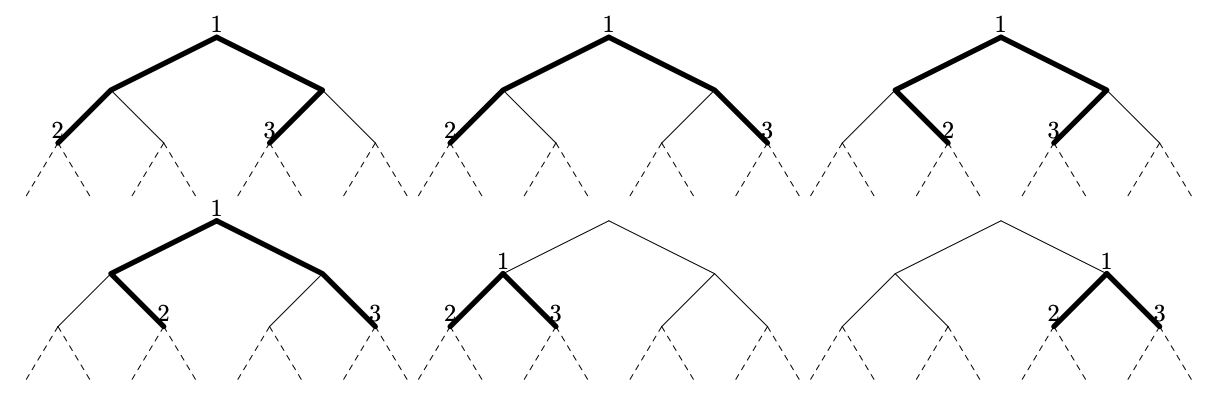
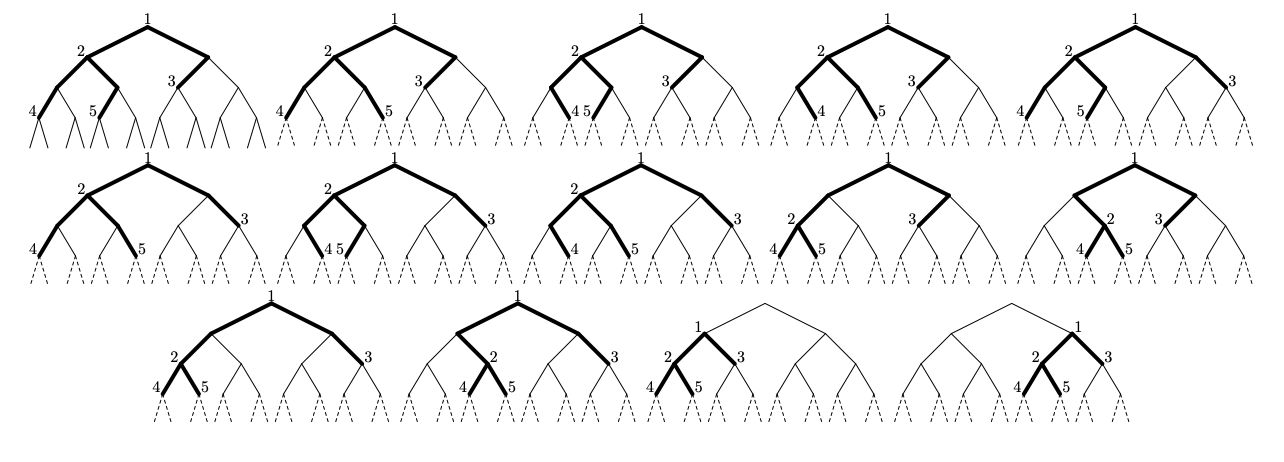
Informally, an embedding is a way to put the vertices of G somewhere on T so that if we draw paths between all the embedded vertices and their children, the drawing looks like G with some of the edges possibly extended downwards (looking at the pictures for the sample cases might help to understand the notion better).
Additionally, for each leaf vertex v Vasya has chosen a number h_v --- the height of the vertex of T that v should be embedded to (the height of a vertex is the number of edges between the vertex and the root of the tree). That is, height(f(v))=h_v must hold for every leaf v of the tree G.
Now, Vasya wants to know the number of different embeddings of G in T such that each leaf v is embedded to a vertex with height h_v. As the number may be quite large, find it modulo 109+7.
The first line contains one integer n --- the number of vertices of G (1≤n≤2000).
The next n lines describe the tree G and the numbers h_v.
If the i-th vertex is an internal vertex, then the first number in the i-th line will be 0, followed by the numbers of its left and right sons respectively.
If the i-th vertex is a leaf, then the first number in the i-th line will be 1, followed by the number h_i for this leaf. All h_i satisfy 0≤h_i≤109.
It is guaranteed that the root of G is the vertex 1.
Print one integer --- the number of appropriate embeddings modulo 109+7.
All six possible embeddings for the first sample (note that the root of G does not have to coincide with the root of T):

All fourteen possible embeddings for the second sample: