 cho.sh
Action Recognition Problem
아직 제출이 없습니다시간 제한3초메모리 제한256 MB문제
The skeleton data has been widely used in computer vision tasks such as action recognition. In the skeleton model, the human body is represented by a set of body joints interconnected by bones. This naturally forms an undirected graph model: vertices are joints and edges are bones.
To incorporate the dynamics of the skeletons in a video, we may keep track of the joints across the frames and build a spatial-temporal graph for the video. The spatial-temporal graph consists of the skeleton graphs of every frame, with additional inter-frame edges connecting the same joints in two adjacent frames. Note that the skeleton graph should keep the same in all frames of the video. The following picture exhibits how a spatial-temporal graph is formed.
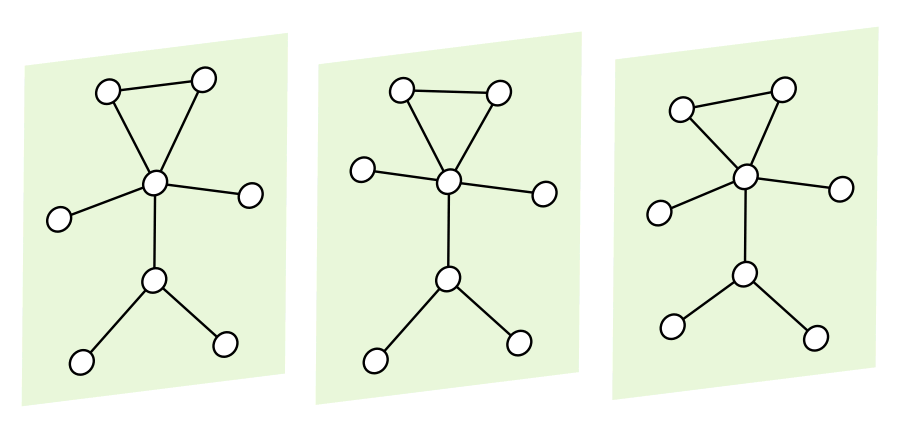 |  | 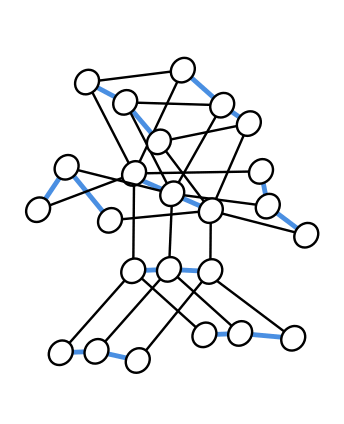 |
| skeleton graphs of 3 adjacent frames | spatial-temporal graph |
Рис. 1: Formation of a spatial-temporal graph
Your task is to reverse-engineer a spatial-temporal graph. Formally, you should assign a pair of integers to every vertex of the graph, where is the frame number and is the index of the joint. Let denote the number of frames and the number of joints, respectively, then your labeling must simultaneously satisfy the following conditions:
- for every and , exactly one vertex is labeled ;
- there is an edge between vertices labeled and for every and ; there are no inter-frame edges other than those mentioned before;
- for every and , there is an edge between vertices labeled and if and only if so between and .
입력
The first line of the input consists of two integers , denoting the number of vertices and edges in the given spatial-temporal graph respectively. The vertices of the graph are indexed through .
Each of the remaining lines of the input contains two integers , denoting an undirected edge connecting vertices indexed and . Each pair of vertices is connected by at most one edge. The input graph is guaranteed to be connected.
출력
Print two integers in the first line of your output, denoting the number of frames and the number of joints, respectively. Then print lines, each containing integers; the -th integer of the -th line is the index of the vertex labeled .
If multiple valid labelings exist, print the one with the maximum number of frames. If there are still multiple, any one is acceptable.