cho.sh
Fiber Shape
아직 제출이 없습니다시간 제한3초메모리 제한512 MB문제
Imagine a board with pins put into it, the -th pin is located at . For simplicity, we will restrict the problem to the case where the pins are placed in vertices of a convex polygon.
Then, take a non-stretchable string of length , and put it around all the pins. Place a pencil inside the string and draw a curve around the pins, trying to pull the string in every possible direction. The picture below shows an example of a string tied around the pins and pulled by a pencil (a point ).
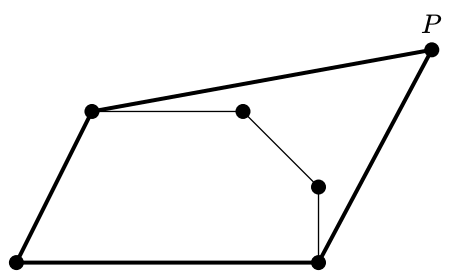
Your task is to find an area inside this curve. Formally, for a given convex polygon and a length let's define a fiber shape as a set of points such that the perimeter of the convex hull of does not exceed . Find an area of .
입력
The first line contains two integers and (; ) --- the number of vertices of the polygon and the length of the string. Next lines contain integers and () --- coordinates of polygon's vertices in counterclockwise order. All internal angles of the polygon are strictly less than . The length exceeds the perimeter of the polygon by at least .
출력
Output a single floating-point number --- the area of the fiber shape . Your answer will be considered correct if its absolute or relative error doesn't exceed .
힌트
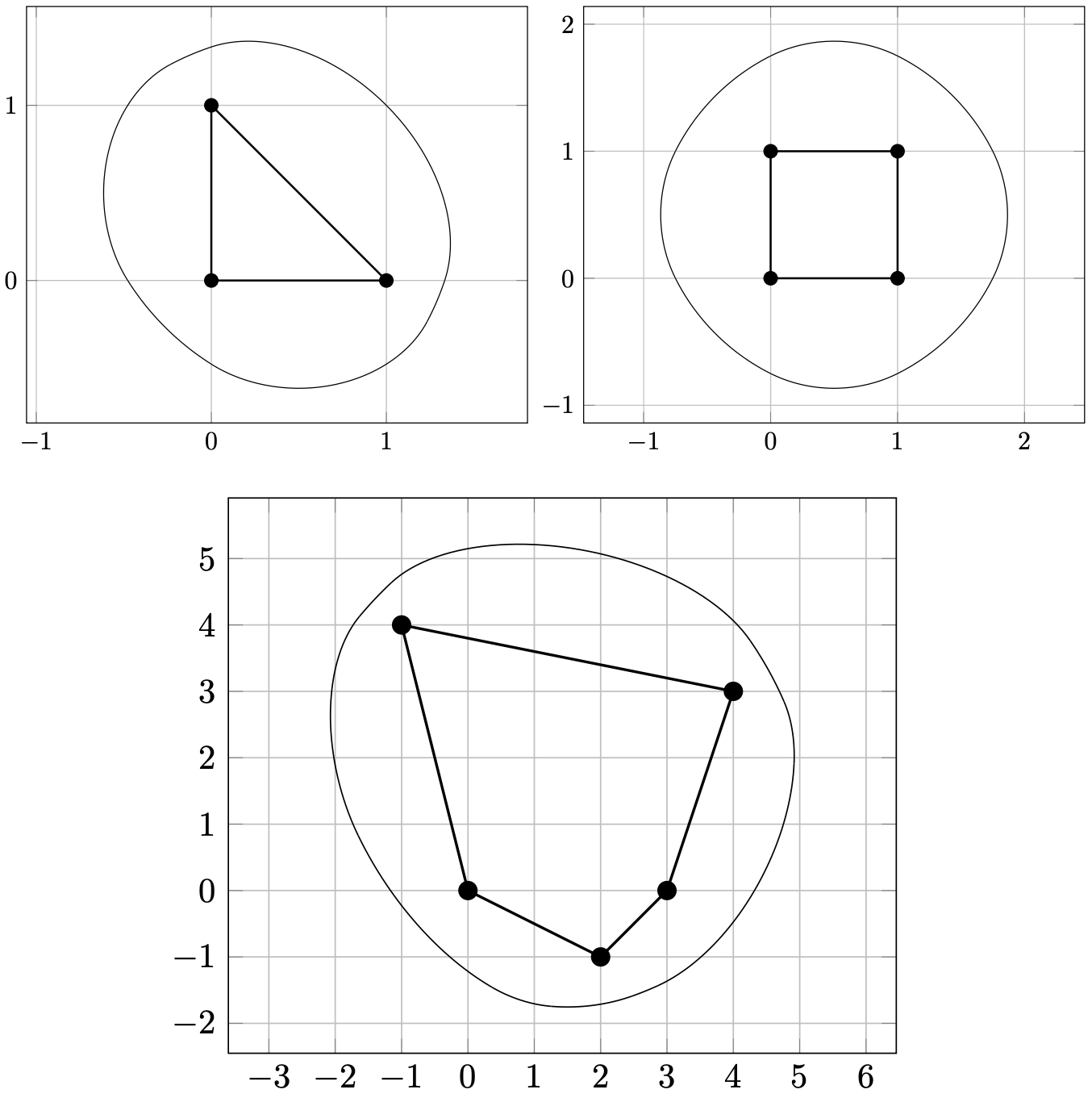
The following pictures illustrate the example tests.