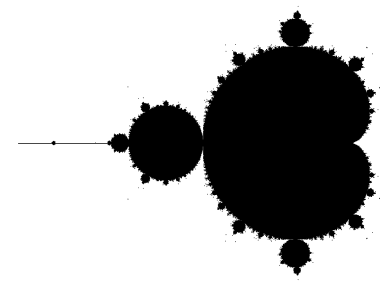
Born in Warsaw, Benoît Mandelbrot (1924-2010) is considered the father of fractal geometry. He studied mathematical processes that described self-similar and natural shapes known as fractals. Perhaps his most well-known contribution is the Mandelbrot set, which is pictured below (the set contains the black points):

The Mandelbrot set is typically drawn on the complex plane, a 2-dimensional plane representing all complex numbers. The horizontal axis represents the real portion of the number, and the vertical axis represents the imaginary portion. A complex number c=x+yi (at position (x,y) on the complex plane) is not in the Mandelbrot set if the following sequence diverges:
z_n+1←z_n2+c
beginning with z_0=0. That is, lim_n→∞∣z_n∣=∞. If the sequence does not diverge, then c is in the set.
Recall the following facts about imaginary numbers and their arithmetic:
i=−1, i2=−1, (x+yi)2=x2−y2+2xyi, ∣x+yi∣=x2+y2
where x and y are real numbers, and ∣⋅∣ is known as the modulus of a complex number (in the complex plane, the modulus of x+yi is equal to the straight-line distance from the origin to the the point (x,y)).
Write a program which determines if the sequence z_n diverges for a given value c within a fixed number of iterations. That is, is c in the Mandelbrot set or not? To detect divergence, just check to see if ∣z_n∣>2 for any z_n that we compute – if this happens, the sequence is guaranteed to diverge.
Each test case is described by a single line containing three numbers: two real numbers −3≤x≤3 and −3≤y≤3, and an integer 0≤r≤10,000. The value of c for this case is x+yi, and r is the maximum number of iterations to compute.
For each case, display the case number followed by whether the given c is in the Mandelbrot set, using IN or OUT.