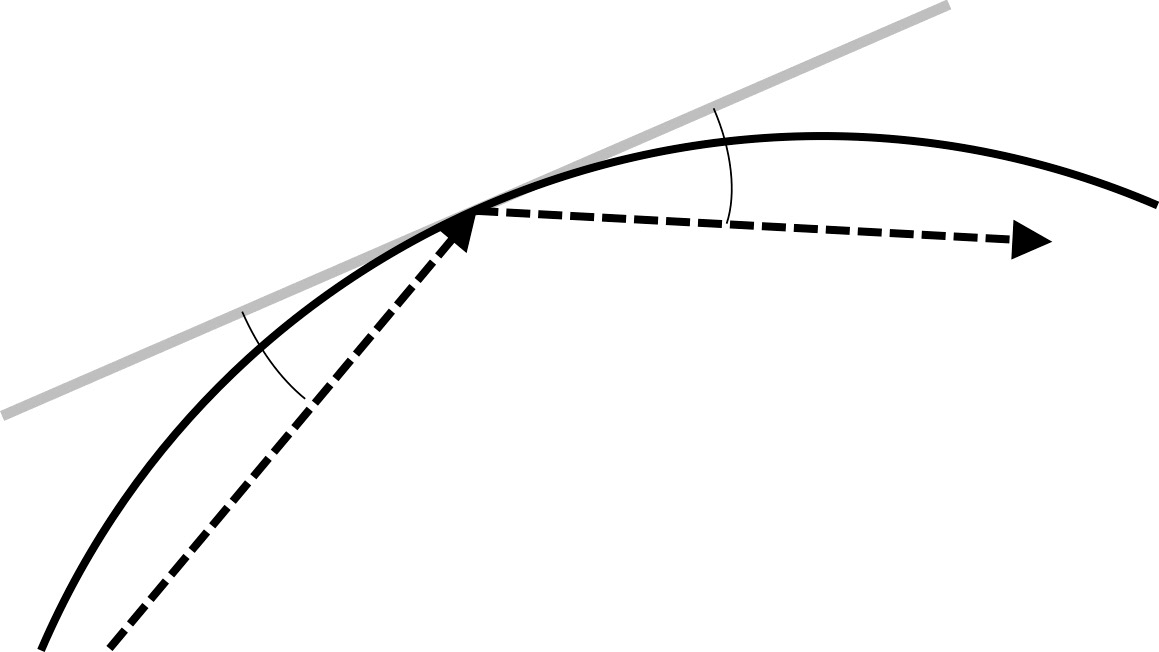
You are standing by the wall in a large, perfectly circular arena and you throw a tennis ball hard against some other part of the arena. After a given number of bounces, where does the tennis ball next strike the wall?
Map the arena as a unit circle centered at the origin, with you standing at the point (−1,0). You throw the ball with a direction given by a slope in the coordinate plane of a rational fraction a/b. Each bounce is perfect, losing no energy and bouncing from the wall with the same angle of reflection as the angle of incidence to a tangent to the wall at the point of impact.

After n bounces, the ball strikes the circle again at some point p which has rational coordinates that can be expressed as (r/s,t/u). Output the fraction r/s modulo the prime M=1,000,000,007.
It can be shown that the x coordinate can be expressed as an irreducible fraction r/s, where r and s are integers and s≡0(modM). Output the integer equal to r⋅s−1(modM). In other words, output an integer k such that 0≤k<M and k⋅s≡r(modM).
For example, if we throw the ball with slope 1/2 and it bounces once, it first strikes the wall at coordinates (3/5,4/5). After bouncing, it next strikes the wall at coordinates (7/25,−24/25). The modular inverse of 25 with respect to the prime M is 280,000,002, and the final result is thus 7⋅280,000,002(modM)=960,000,007.
The single line of input will contain three integers a, b (1≤a,b≤109,gcd(a,b)=1) and n (1≤n≤1012), where a/b is the slope of your throw, and n is the number of bounces. Note that a and b are relatively prime.
Output a single integer value as described above.
Note that Sample 2 corresponds to the example in the problem description.