 cho.sh
Permutation Transformation
아직 제출이 없습니다시간 제한1초메모리 제한512 MB문제
Fedor works in the department of permutation transforming. Today Fedor should solve the following problem: he needs to transform the permutation of integers to the permutation using at most -transfer operations.
Consider an array of length . The -transfer operation with the parameters is defined as follows: a segment of consecutive elements starting with an element at index is cut away from the array and inserted back starting with the index .
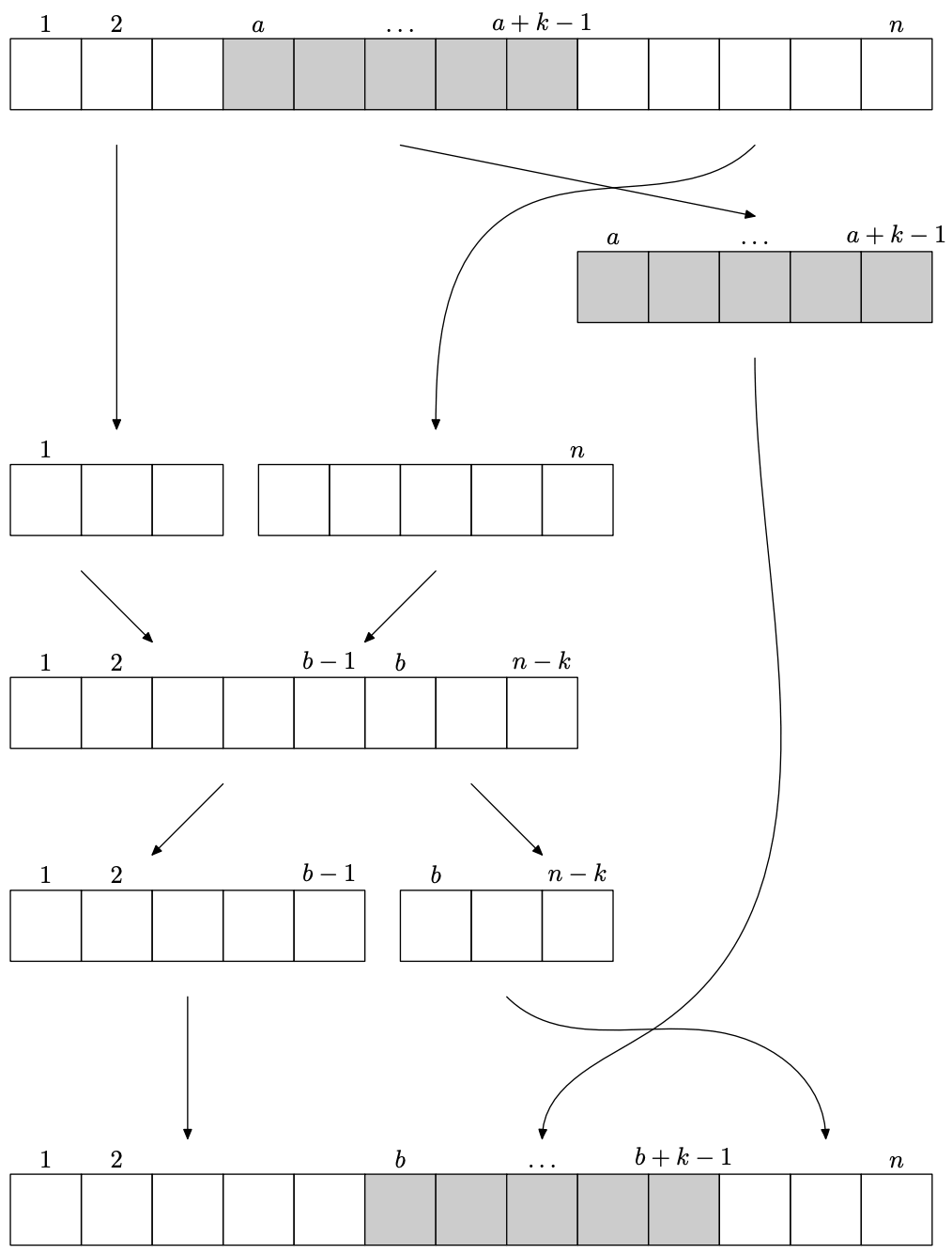
More formally: consider an array and two integers and (). Let's create the temporary array , consisting of the numbers . Then the result of the -transfer with parameters for an array is an array, consisting of the numbers .
Fedor doesn't know how to solve the task, so he asks you to help him!
You are to solve the problem for test cases.
입력
The first line contains a single integer () --- the number of test cases.
Each test case consists of three lines. The first line contains two integers and ().
The second line contains different integers () --- the permutation .
The third line contains different integers () --- the permutation .
It's guaranteed that the sum of over all test cases doesn't exceed .
출력
Print the answer for each test case. Output your answer for a single test case in the following format.
If it's impossible to obtain a permutation from a permutation using -transfers, print a single line consisting of the word "NO".
Otherwise, print "YES" at the first line.
The second line must contain a single integer --- the number of -transfers performed to obtain the permutation from the permutation (). Note that you don't need to minimize . It's guaranteed that if the permutation can be obtained from the permutation using -transfers, then there is a solution that requires at most operations.
Each of the following lines should contain two integers --- parameters and for the corresponding -transfer.
힌트
In the third test case there is another way to obtain a permutation from a permutation --- a single -transfer with the parameters , .