Be Careful

아직 제출이 없습니다시간 제한1초메모리 제한1024 MB

문제

You are given a rooted tree with nn vertices, where the root is vertex 11. A vertex is a leaf if it is not the root vertex and its degree is exactly 11.

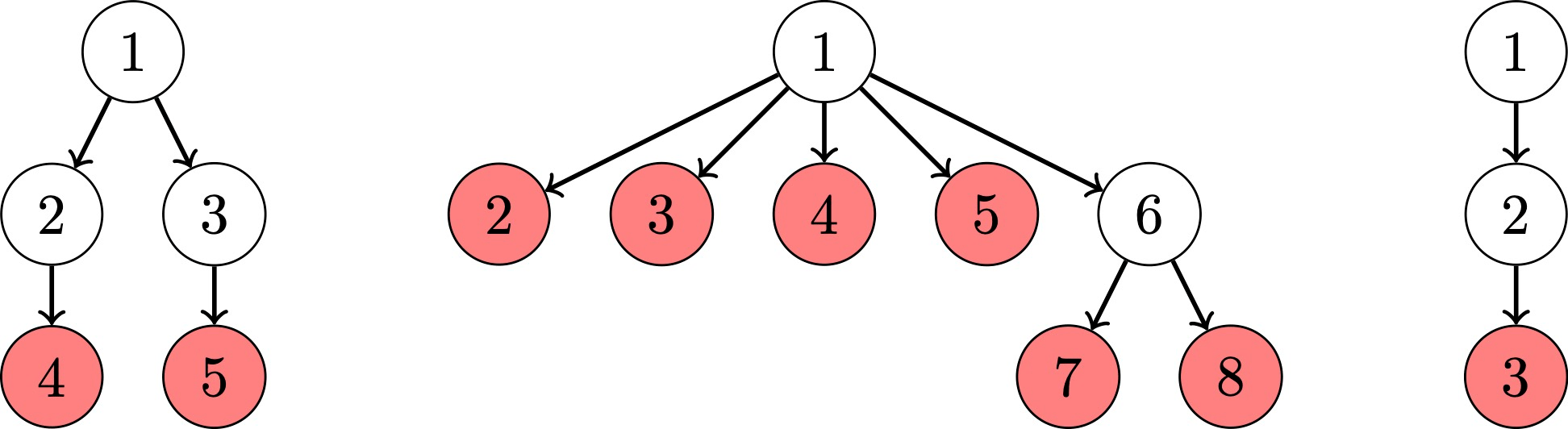
The figure corresponds to the sample tests, where the leaves are marked red.

Let mex(S)\operatorname{mex}(S) be the minimal non-negative integer that is not present in SS. For example, mex0,1,3,4=2\operatorname{mex}\\{ 0, 1, 3, 4 \\} = 2, mex2,3=0\operatorname{mex}\\{2, 3\\} = 0, mex=0\operatorname{mex} \varnothing = 0.

Let mm be the number of leaves in the given tree. You will perform the following procedure:

  1. For every leaf vertex uu, write any integer from 0,1,2,,n\\{0, 1, 2, \ldots, n\\} to the vertex uu.
  2. For every non-leaf vertex uu, the integer written in uu will be the mex\operatorname{mex} of the integers written in all the sons of vertex uu.

For example, for the first tree which is described in the figure above, if we write integer 00 to vertex 44 and integer 33 to vertex 55, then:

  • The integer written in vertex 22 will be mex0=1\operatorname{mex}\\{0\\} = 1.
  • The integer written in vertex 33 will be mex3=0\operatorname{mex}\\{3\\} = 0.
  • The integer written in vertex 11 will be mex1,0=2\operatorname{mex}\\{1, 0\\} = 2.

In total, there are (n+1)m(n+1)^m ways to fill the tree. You would like to know, for all k0,1,2,,nk \in \\{0, 1, 2, \ldots, n\\}, how many ways are there to fill the tree so that the number written in vertex 11 will be exactly kk. Since the numbers can be huge, you only need to output them modulo 998,244,353998\\,244\\,353.

입력

The first line of the input consists of a single integer nn (2n2002 \le n \le 200).

Each of the next n1n-1 lines contains two integers xx and yy (1x,yn1 \le x,y \le n, xyx \ne y), indicating that there is an edge between vertices xx and yy. It is guaranteed that the given graph is a tree.

출력

Output n+1n+1 lines. In the ii-th line output a single integer, indicating the answer for k=i1k = i - 1, modulo 998,244,353998\\,244\\,353.