This is an interactive problem.
You need to maintain a rooted tree with vertex 1 as the root. The tree has n vertices, and the parent of vertex i (2≤i≤n) is p_i (1≤p_i<i).
You have to process q queries, each in one of the following forms:
? a b": Output the set S, where S is the set consisting of all vertices on the unique simple path from a to b.= a b": Change the parent of a to b (that is, p_a←b). It is guaranteed that the vertices still form a tree after the modification, but it is not guaranteed that b\<a.But you soon discover a problem: the size of the set S may be too large, you can't output all elements in each query.
To deal with this issue, you have designed a special computer. This special computer can maintain sets of integers and operate on them quickly. Initially, the computer has only n+1 sets S_0,S_1,…,S_n where the set S_0=∅, and S_i=i for all 1≤i≤n.
This computer is efficient and at the same time very simple: it supports only two different operations!
+ a b": Construct a new set S_c=S_a∪S_b (S_a∩S_b=∅), with c being the maximum of the ID of all sets plus one. You have to make sure that S_a∩S_b=∅. The cost of this operation is ∣S_a∣+∣S_b∣.! k x_1 x_2 … x_k": Print the set S_x_1∪S_x_2∪⋯∪S_x_k as the answer to the query. You need to ensure that S_x_i∩S_x_j=∅ for all 1≤i<j≤k. The cost of this operation is k.Now, you need to use this computer to maintain the rooted tree. In order to avoid calculations consuming too much time and causing damage to the computer, there are the following restrictions when using the computer.
The first line of the input contains two integers n and q (1≤n≤2⋅105, 1≤q≤2.5⋅104).
The next line of the input contains n−1 integers p_2,p_3,…,p_n (1≤p_i<i), indicating the initial parent of each vertex.
The sample input and output are intended only to illustrate the interaction protocol. The string "<flush the output>" and the blank lines are only added for the reader's convenience. You should not output this information.
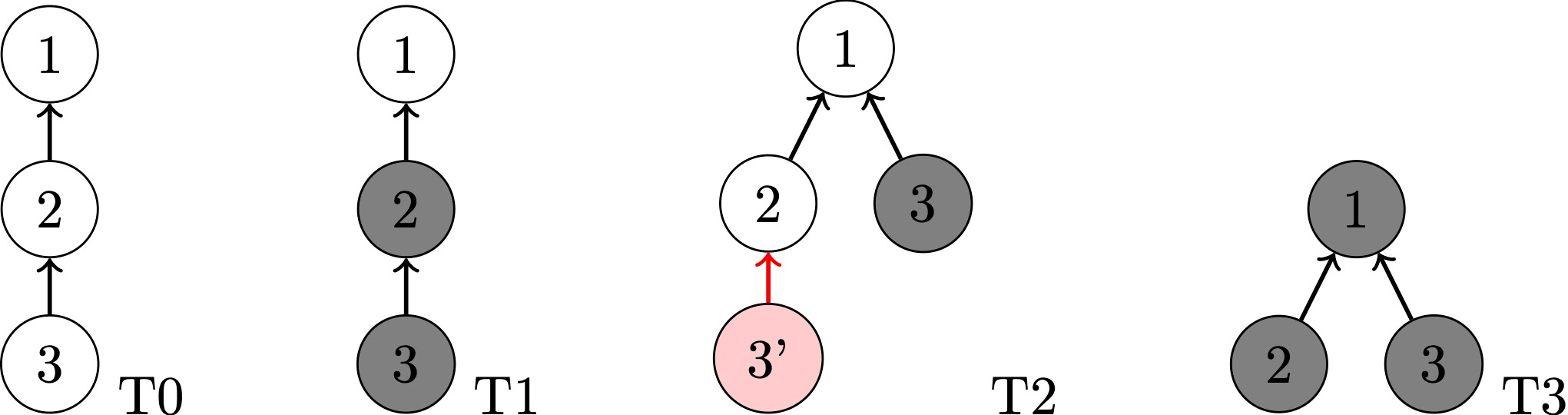
Here's the figure of the sample test case:

The figure corresponds to the sample test case