cho.sh
Geometry
아직 제출이 없습니다시간 제한3초메모리 제한1024 MB문제
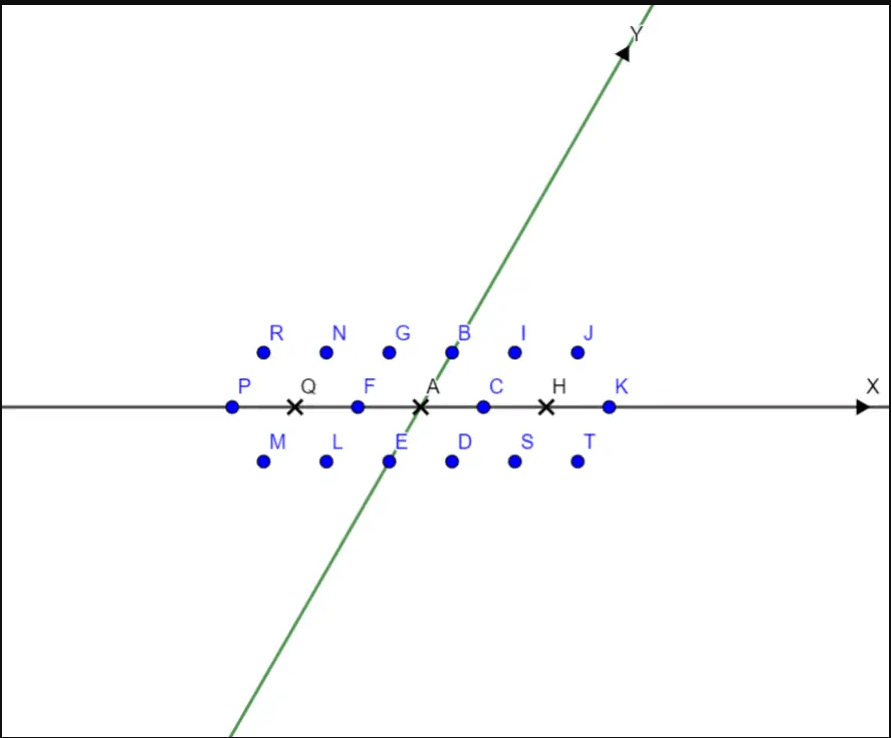
Grammy has a special two-dimensional coordinate system: the angle between the positive half-axis of the -axis and the positive half-axis of the -axis is degrees.
Consider the following graph. The vertices are all integer coordinates such that at least one of is odd and , , . The edges from go to , , , , , and .
Find the size of the maximum independent set of vertices in this graph. Additionally, find the number of such sets modulo .
입력
The first line contains an integer (), denoting the number of test cases.
Each of the following lines contains three integers , , ().
출력
Output lines. Each line must contain two integers: the size of the maximum independent set and the number of such sets. Please note that the size should not be taken modulo .
힌트
The following picture shows the situation for the first and second test case of the sample.
Point has coordinates , point has coordinates , and point has coordinates . Among these three points, only has even -coordinate and even -coordinate. The neighbours of point are .
In the first test case, the points that satisfy the conditions are .
The size of the maximum independent set is , and there are ways: , , , .
In the second test case, the points that satisfy the conditions are .
The size of the maximum independent set is , and there is one way: .