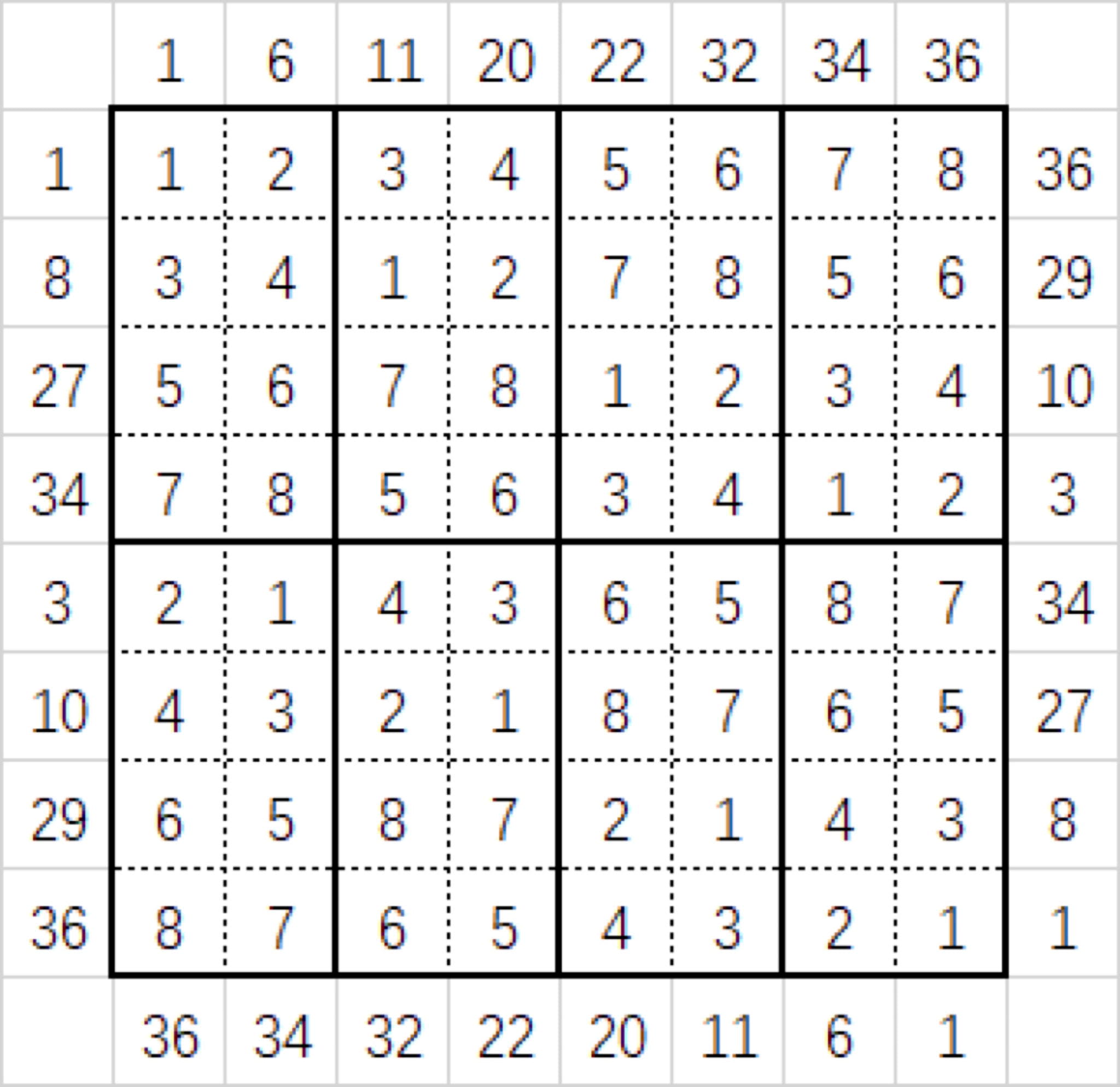
An n×m sudoku puzzle is a grid consisting of m×n regions, and each region contains n×m cells. Hence an n×m sudoku puzzle contains nm×nm cells. Every integer from 1 to nm occurs exactly once in each row, each column, and each region of an n×m sudoku puzzle.
Listing the integers in a row or a column starting from some direction as a sequence of length nm, X is the first integer of the sequence, and X-sum is the sum of the first X integers of the sequence.

The above figure is a 4×2 sudoku puzzle with X-sums. The 7-th row listed from right to left is \[3,4,1,2,7,8,5,6] and the first integer X is 3, so the X-sum of the 7-th row from the direction right is 8=3+4+1.
Given two positive integers n and m, a direction d, and an index x, you need to find the X-sum of the x-th row or x-th column from the direction d in the lexicographically smallest 2n×2m sudoku.
Denoting a_i,j as the i-th row and the j-th column of a sudoku puzzle a, a sudoku puzzle a is lexicographically smaller than a sudoku puzzle b of the same size if there exists i and j satisfying that a_i,j\<b_i,j, that a_x,y=b_x,y for all x\<i, and that a_x,y=b_x,y for all x=i and y\<j. You can find that the above is the lexicographically smallest 4×2 sudoku puzzle.
There are multiple test cases. The first line of input contains an integer T(1≤T≤105), the number of test cases.
For each test case:
The only line contains two integers n and m (1≤n, m≤30), a string d, and an integer x (1≤x≤2n+m). Here, 2n×2m is the size of the sudoku puzzle; d is the direction of X-sum, and it is one of "left", "right", "top", and "bottom"; x is the index of a row or a column.
For each test case:
Output an integer: the X-sum of the x-th row or x-th column from the direction d in the lexicographically smallest 2n×2m sudoku.
Note that the answer may exceed 264−1. Consider using __int128_t in C++, BigInteger in Java or Kotlin, or int in Python.