 cho.sh
LaLa and Magical Beast Summoning
아직 제출이 없습니다시간 제한5초메모리 제한1024 MB문제
is about to cast a al beast summoning .
The first thing do is creating a summoning field, which has 3 constants associated with it: nullity , elasticity , and viscosity . Such summoning field is denoted by
A al beast summoning is performed over a summoning cell within the summoning field, which is square-shaped and is associated with 3 variables: side length , agility , and intelligence . Such summoning cell is denoted by .
is in a null state if . Otherwise, it is in a positive state.
The density of in positive state is defined as .
The problem of determining whether a al beast summoning will succeed requires very heavy computation involving solving a system of -th order partial differential equations over variables. Fortunately, already did all the math for you!
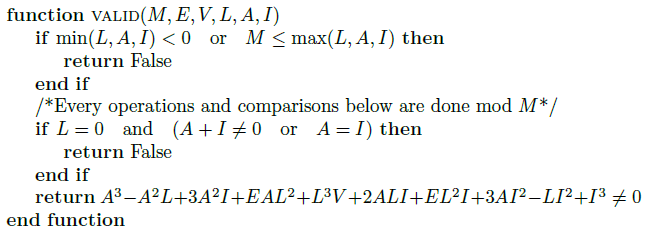
The al beast summoning over within succeeds if and only if the function defined by the pseudocode in the note section returns true. We'll call such summoning cell valid.
Sometimes, isn't satisfied with the set of summoning cells she has, and wants to generate new ones by combining them. The problem of determining the result of combination of two valid summoning cells and within requires another heavy computation, but thankfully, already did all the math for you again!
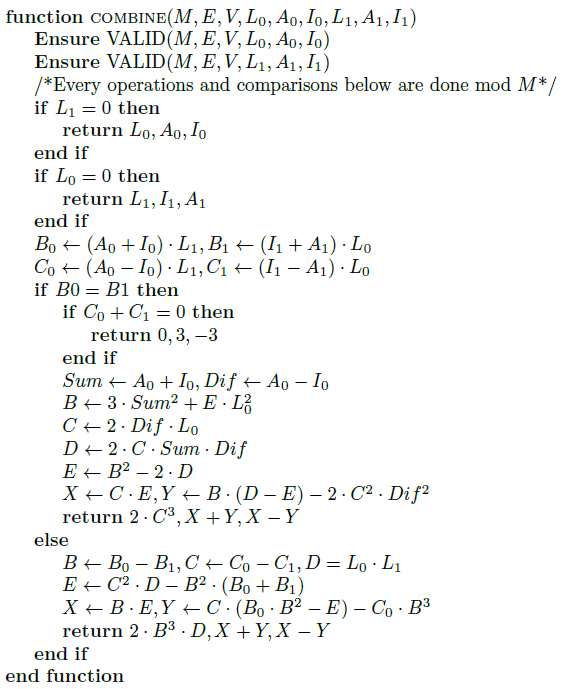
The result of combining two such cells and within , denoted by , is given by the function defined by the pseudocode in the note section, which returns a triple satisfying . Here, it can be proved that is also valid. Note that swapping the order of and affects the result.
The result of combining cells within is given recursively by
For the sake of completeness, we define .
is aware of a very special property about the combining operation that allows her to efficiently solve the range density query problem below. Can you figure it out?
You're given a summoning field and an array of valid summoning cells within . Write a program that processes the following two types of queries:
1 i L A I- Set .
2 l r- Let . If is in the null state, print a single integer . Otherwise, print the density of , modulo . Here, an irreducible fraction , where is a non-negative integer and is a positive integer not divisible by , modulo is defined to be the unique integer where is the multiplicative inverse of modulo . It can be proved that if is in the positive state, the denominator of the density of as an irreducible fraction is not divisible by within the constraints of this problem.
입력
The input is given in the following format:
Here, denotes the -th query, and is given in the format described in the statement.
The input satisfies the following constraints:
- All the numbers in the input are integers.
- is a prime such that
- for all integers
- within is valid for all integers .
- For each query
1 i L A I, , , and is valid within . - For each query
2 l r,
출력
For each query of the second type, print its answer in a single line.
힌트
The following pseudocode defines the validity of summoning cells and the operation.
Both functions do not modify their arguments
The author has attached a C++ implementation which will get "Time Limit Exceeded" verdict upon submission, but it will always print the correct answer within finite time. You may reuse some part of the implementation on your submission. You can find it on the "Problemset" tab on the domjudge site.