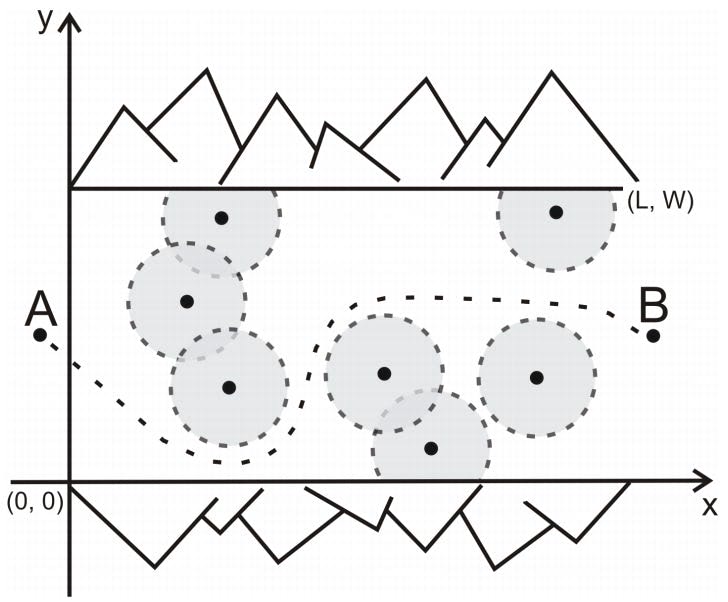
A group of war prisoners are trying to escape from a prison. They have carefully planned the breakout itself, and afterwards they hope to find shelter in a nearby village. However, the village (marked B in the figure below) and the prison (marked A) are separated by a canyon that is guarded by soldiers.

Each soldier sits at a fixed picket and rarely moves, and every soldier can see exactly 100 meters in every direction. Depending on where the soldiers stand, it may be possible to cross the canyon safely by keeping the distance to the closest soldier strictly greater than 100 meters at every moment.
Given the length and width of the canyon and the coordinates of every soldier, and assuming the soldiers never move, first decide whether the prisoners can cross the canyon unnoticed. If that is impossible, the prisoners want to know the minimum number of soldiers that must be eliminated so that a safe crossing becomes possible. A soldier may be eliminated whether or not any other soldier can see him.
The first line contains three integers $L$, $W$, and $N$ — the length of the canyon, the width of the canyon, and the number of soldiers.
Each of the next $N$ lines contains two integers $X_i$ and $Y_i$ — the coordinates of the $i$-th soldier ($0 \le X_i \le L$, $0 \le Y_i \le W$). Coordinates are measured in meters relative to the canyon: the southwestern corner is $(0, 0)$ and the northeastern corner is $(L, W)$.
A crossing may begin at any point $(0, y_s)$ with $0 \le y_s \le W$ and end at any point $(L, y_e)$ with $0 \le y_e \le W$. Neither $y_s$ nor $y_e$ has to be an integer.
Print a single integer: the minimum number of soldiers that must be eliminated so that the prisoners can cross the canyon safely. If they can escape without eliminating anyone, print 0.