Pie Max Flow
Time limit1sMemory limit256 MB
Given a wheel of N spokes from vertex 0 with capacities A and a rim cycle with capacities B, compute each sink's max flow from 0 and output their sum.
- Level
Hard8 of 10
- Topics
- Graph, Shortest path, Greedy, Implementation
- Solved
- No attempts yet
Problem
There is a graph with N + 1 vertices numbered 0 to N. For each i with 1 ≤ i ≤ N, an edge with capacity Ai connects vertices 0 and N. For each i with 1 ≤ i ≤ N, an edge with capacity Bi connects vertices i and ((i mod N) + 1). There are no other edges in the graph. All edges are undirected.
A flow in a graph from a source vertex s to a sink vertex t assigns to each edge e = (v1, v2) a direction (either v1 → v2 or v2 → v1) and a number Fe such that 0 ≤ Fe ≤ Ke, where Ke is the capacity of edge e. We say that there are Fe units of flow in the specified direction, out of one vertex and into the other. Every flow must satisfy the constraint that for each vertex v except the source and sink, the sum of the flows out of v equals the sum of the flows into v. The maximum flow from s to t is the maximum over all flows from s to t of the sum of flows out of s minus the sum of flows into s.
Let Ci be the maximum flow from vertex 0 to vertex i. Find the value of C1 + · · · + CN.
Sequences A and B will not be given directly. Instead N, A1, B1 and integers P, Q, W, X are given. Then for i > 1:
- Ai = (PAi−1) mod Q
- Bi = (WBi−1) mod X
Input
Line 1 contains one integer N (2 ≤ N ≤ 220).
Line 2 contains three integers A1, P, Q (1 ≤ A1, P, Q ≤ 229).
Line 3 contains three integers B1, W, X (1 ≤ B1, W, X ≤ 229).
Output
Print one line with one integer, the value of C1 + · · · + CN.
Hint
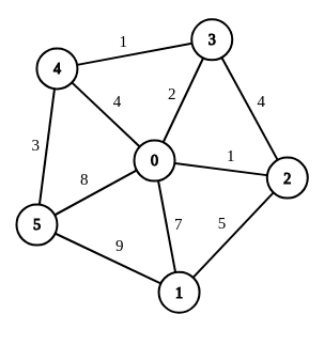
For the first example, A = [7, 1, 2, 4, 8], B = [5, 4, 1, 3, 9], C = [20, 9, 7, 8, 20]. The graph is shown below.