 cho.sh
Mr. Panda and Blocks
아직 제출이 없습니다시간 제한1초메모리 제한256 MB문제
Mr. Panda recently received a bucket of toy blocks as his birthday gift. Each block is a cuboid, which is constructed by a pair of face-to-face colored cubes. There are types of colors, labeled as .
Mr. Panda checked all of the blocks, and he found that he had just blocks and each of these blocks was painted with a unique pair of colors. That is, for each pair of colors , he had exactly one block with one cube colored , and the other colored .
Mr. Panda plans to build a fantastic castle with these blocks today.
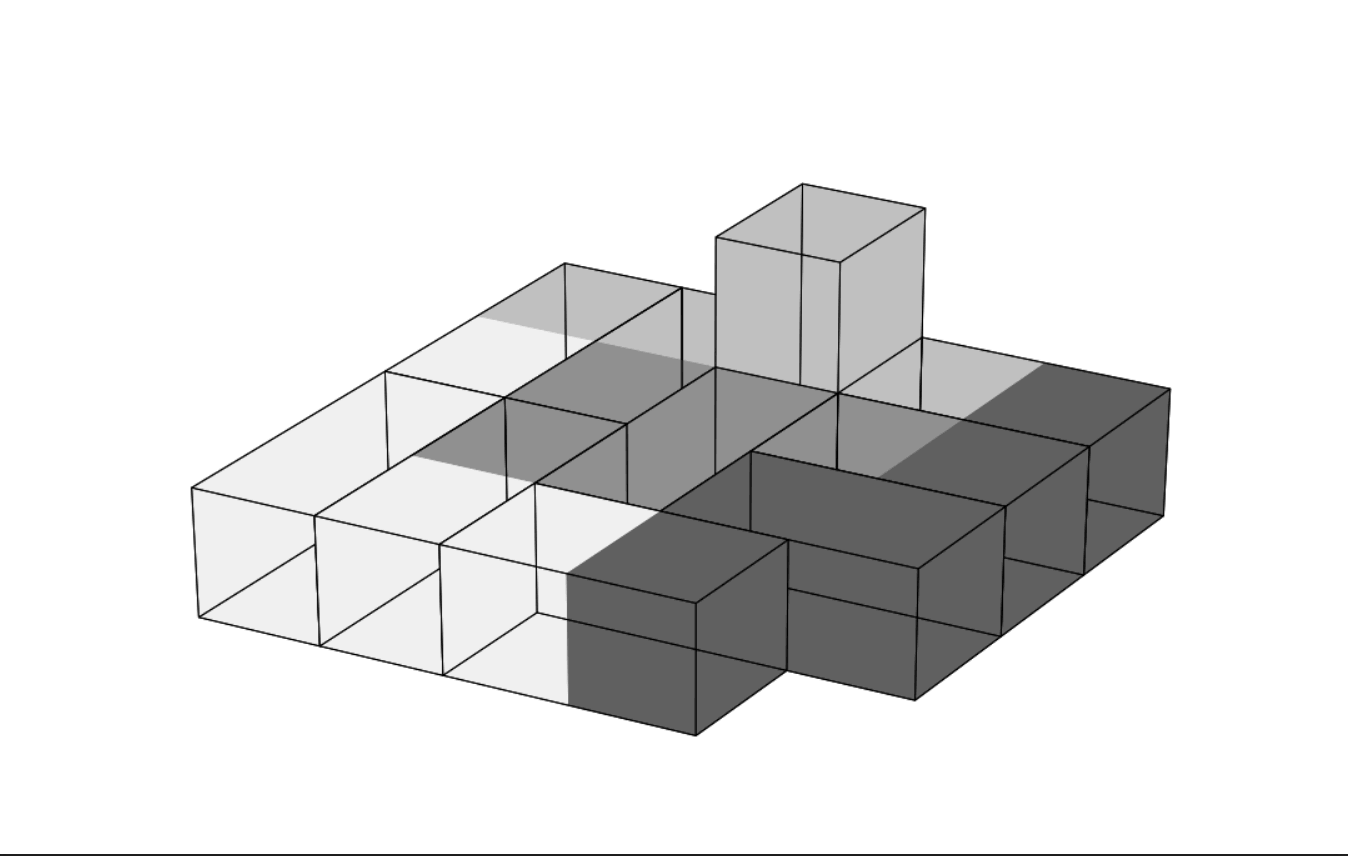
Firstly, he defines an attribute called connected:
- If cube A shares a face with cube B, they are connected.
- If cube A and cube B are connected, and cube B and cube C are connected, then cube A and cube C are connected.
- If all pairs of cubes in the castle are connected, the castle is connected.
Then he comes up with the following requirements:
- The whole castle should be connected.
- For any color , if only consider the cubes with that color, the sub-castle formed by these cubes should also be connected.
However, after many attempts, Mr. Panda still cannot build such a castle. So he turns to you for help. Could you please help Mr. Panda to build a castle which meets all his requirements?
입력
The first line of the input gives the number of test cases, (). test cases follow.
For each test case, one line contains an integer (), representing the number of colors.
출력
For each test case, first output one line containing "Case #x:", where x is the test case number (starting from 1).
If it's impossible to build a castle that satisfies Mr. Panda's requirements, output a single line containing "NO" (quotes for clarity).
If it's possible to build the castle, first output a single line containing "YES" (quotes for clarity).
Then, output lines describing the coordinates of all the blocks. Each of these lines should be outputted in the form of ), which means for the block , the cube with color is located at and the other cube with color is located at . You should make sure that each pair of occurs exactly once in your answer.
In case there is more than one solution, any of them will be accepted.