 cho.sh
Rotate Sum 2
아직 제출이 없습니다시간 제한1초메모리 제한1024 MB문제
Grammy loves geometry. Today, she takes out her precious convex polygon and plays with it on a piece of paper. The polygon has vertices numbered from to in counterclockwise order. For vertex , the next vertex in this order is , and the previous one is .
Firstly, Grammy draws a horizontal line on the paper. Secondly, she chooses two vertices and of the polygon independently and equiprobably. Thirdly, she places the edge between vertex and vertex on the line, landing all other vertices above the line, and draws a vertical line through vertex . Next, she rotates the polygon clockwise, taking vertex as the rotation center, until vertex hits the line. When vertex hits the line, she changes the rotation center to vertex and rotates again until vertex (the next after ) hits the line. She repeats this operation until vertex hits the line again. Finally, she draws another vertical line through the vertex and calculates the area between the trajectory of vertex and the three lines.
Since you do not know which points Grammy will choose, you want to calculate the expected value of the area.
입력
The first line contains a single integer (), denoting the number of vertices in the polygon.
Each of the following lines contains two integers and (), denoting the coordinates of a vertex of the polygon. The vertices are given in counterclockwise order. It is guaranteed that the polygon is strictly convex.
출력
Output a single real number denoting the expected area. The answer is considered correct if its absolute of relative error does not exceed .
힌트
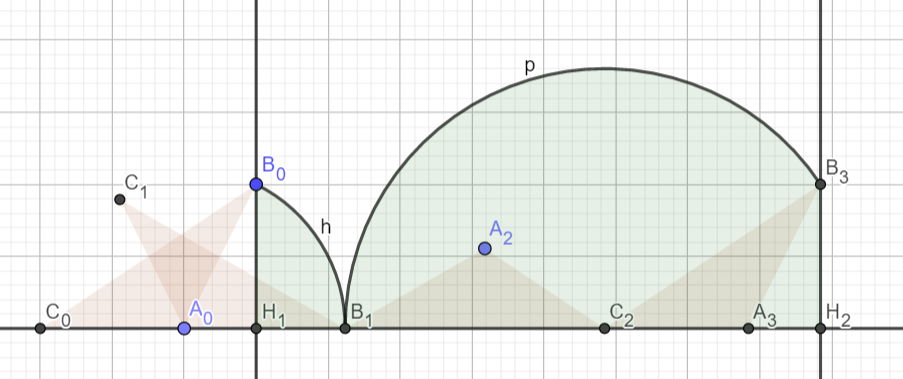
For the first example, if the -th vertex is marked as , and the -th vertex is marked as , then the polygon will be after rotations, and the trajectory of vertex is arc and arc . The area of the green part is the answer in this case.}